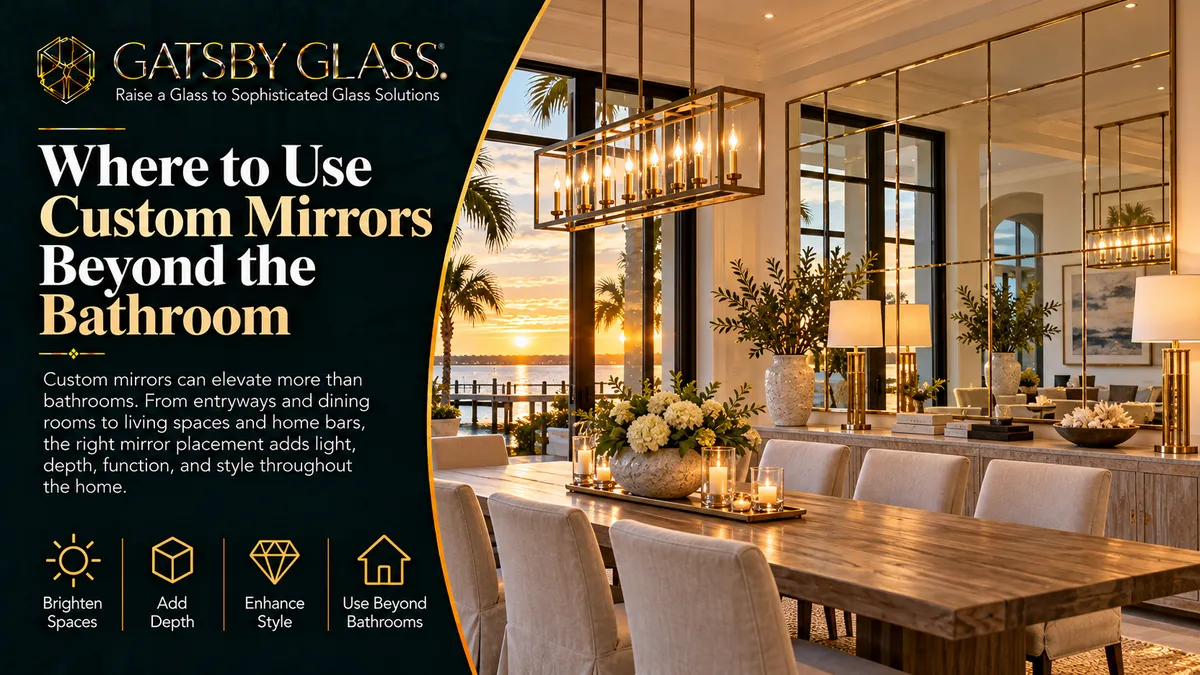
Where to Use Custom Mirrors Beyond the Bathroom
Custom mirrors aren’t just for vanities. Discover where they work best in Charleston homes and businesses, from entry halls and dining rooms to home offices and retail spaces, and how to size them so they look built in.
Where to Use Custom Mirrors Beyond the Bathroom
Think about the last time you walked into a room and thought, this space just works. The light felt right, the room seemed bigger than it was, and nothing felt crowded. There’s a good chance a mirror was doing a lot of that work, and you never noticed it.
That’s what a well-placed mirror does. It doesn’t announce itself. It quietly changes how the room feels.
Yet in most Charleston homes, mirrors live in one place: the bathroom. It’s the one room where a mirror is obviously needed, so it’s the one room where everyone has one. Everywhere else, you get a decorative mirror hung at eye level, usually a size or two too small for its wall, doing very little.
If you’ve been thinking about ways to make a dark hallway feel welcoming, a dining room feel more elegant, or a small home office feel less boxed in, a custom mirror is one of the most effective and least disruptive options. No demolition, no new walls, and no major renovation. Just glass cut to fit a specific wall, placed where it can work.
This guide covers where custom mirrors do the most good beyond the bathroom, why they work so well in Charleston homes specifically, and how to get the details right so the result looks like it was always part of the house.
The Problem Most Charleston Rooms Share
Charleston’s housing stock is wonderfully varied, and almost all of it has the same handful of problems.
Historic single-houses and double-houses have beautiful proportions and genuinely lovely details, but many of their interior rooms are narrow, and their hallways are tighter than any modern floor plan would allow. Windows were placed for ventilation and street presence, not to flood every room with daylight. The result is that a home can be full of character and still have rooms that feel a little dim.
Mid-century homes in West Ashley, James Island, and the older parts of Mount Pleasant have a different version of the same issue: compact rooms, lower ceilings, and floor plans that were efficient but not especially generous.
Even newer construction isn’t immune. Large open-plan homes in Nexton, Cane Bay, and Carolina Park often have big windows but walls that are blank and far from the light, so the middle of the room can feel flat.
The common thread is that the space has potential the current design isn’t using. Light is available, but it isn’t reaching the parts of the room that need it. And the room reads smaller than it really is.
A mirror addresses both problems at once. It sends light deeper into the room, and it extends what the eye sees. That’s the principle behind everything in this guide.
How a Custom Mirror Actually Changes a Room
It helps to understand why this works, because it explains where to put a mirror and how big to make it.
It multiplies light. Daylight from a window travels in a straight line until it hits a surface. A mirror intercepts that light and redirects it. Place one where it can catch the light from a window, and it sends that light into a corner that would otherwise stay in shadow. In the evening, it does the same thing with lamps, candles, and pendant lights.
It extends the room. The eye reads a reflection as continued space. A large mirror on one wall makes the room look like it keeps going. The room doesn’t get bigger, but it stops feeling closed in.
It brings the outside in. A mirror placed across from a window reflects the view, whether that’s a garden, a street lined with live oaks, or the marsh. The landscape appears in the room twice.
All three effects scale with size. A small mirror makes a small difference. A mirror that fills a wall changes the room. That’s the main reason custom sizing matters, and we’ll come back to it.
Where Custom Mirrors Work Best
1. The Entry Hall
If you only add one mirror outside the bathroom, make it this one.
Entry halls in Charleston homes are often narrow and dim, and they’re also the first impression every guest gets. A tall mirror running along one wall, from near the floor to near the ceiling, makes the hall look roughly twice as wide. It pulls light from the front door sidelights or a nearby window down the length of the corridor, and it makes the entrance feel generous instead of compressed.
A frameless mirror with polished edges works especially well here. A heavy frame adds visual weight to a space that is already tight, while a frameless mirror just reads as an extension of the wall.
2. The Dining Room
Dining rooms are where mirrors have the longest tradition and the biggest payoff. Historic Charleston homes often used mirrors in the dining room for exactly the reasons that still apply: they make a room feel richer, and they double the glow of candlelight and chandeliers.
A full-wall custom mirror across from a window brings the garden or street into the room a second time. In the evening, light from the table reflects back, and the room feels fuller and more celebratory. Guests sitting at the table see the room from several angles at once, which is part of what makes a dining room feel like an occasion.
This is also where precise fabrication matters most. Historic dining rooms usually have chair rails, baseboards, and plaster molding, and a mirror cut to fit around them looks original to the room. A standard size leaves gaps and looks like an afterthought.
3. The Living Room
In a living room with windows facing the water, the marsh, or a tree canopy, a large horizontal mirror on the opposite wall does something remarkable. It reflects the view back into the room, so the landscape appears on both sides. It also pushes afternoon light into the part of the room that normally goes dim after the sun moves.
The trick is scale. A mirror that fills most of the wall reads as an architectural feature, as if the room had a second window. A small one reads as decoration. If you’re unsure, size up.
4. The Bedroom
Bedrooms in older Charleston homes often have strange proportions, such as high ceilings with a narrow footprint or a low ceiling over a wide floor. A floor-to-ceiling mirror on one wall helps correct that without touching the structure. It adds apparent height, widens the room, and catches morning light from an east-facing window.
In coastal homes, where the palette tends to be pale and uncluttered, a frameless mirror fits right in. It doesn’t add color or weight, only light and depth.
5. The Home Office
More Charleston homeowners are working from home, and many have carved a workspace out of an open floor plan or a spare room with limited light. A mirror on a side wall bounces window light toward the desk, which keeps the workspace from feeling closed in and reduces the harsh contrast between a bright window and a dark wall.
If you’re also considering glass walls and partitions to define the office, the two work well together. The partition separates the workspace from the rest of the home without blocking light, and the mirror multiplies the light that passes through it.
6. Stair Landings and Hallways
A landing is an awkward space. It’s a transition, so it rarely gets any design attention, and it’s often darker than the floors above and below. A custom mirror on a landing wall brightens it and makes the stairwell feel intentional.
Combined with glass railings, a mirrored landing carries light and openness through the whole vertical run of the house. Light from an upper window travels down through the glass railing and bounces off the mirror, so the staircase feels bright instead of like a corridor.
7. Powder Rooms
A powder room is often the smallest room in the house and the one guests remember. A mirror that fills the wall, from the sink backsplash to the ceiling and from one side wall to the other, transforms a closet-sized room into something that feels designed. It’s the best return on a small space.
8. Mud Rooms and Back Entries
Coastal homes, especially beach houses and waterfront properties, have back entries where people come and go with wet towels, sandy shoes, and sunscreen. These spaces rarely get design attention. A mirror in a mud room serves a practical purpose, since it’s the last look before heading out, and it brings light into a room that usually has none of its own.
9. The Home Gym
A home gym needs a mirror for checking form. A custom wall mirror does that better than a leaning panel or a stack of small mirrors: it’s mounted flush, sized to the wall, and finished with a safety backing. It also makes a converted spare bedroom or garage space read as a proper studio, because the mirror is part of the room instead of an add-on.
10. Retail Spaces and Restaurants
Mirrors work just as hard in commercial spaces. Boutiques use a back-wall mirror to make a compact selling floor feel deeper, which encourages customers to browse longer. Fitting rooms need properly sized, well-lit mirrors, because that’s where purchase decisions happen. Restaurants have used a mirror behind the bar for generations, multiplying the bottles, the light, and the energy of the room.
For businesses already planning a storefront upgrade, mirrors fit naturally with commercial storefront glass. The storefront lets daylight in, and the mirrors spread it through the interior so the whole space feels brighter and bigger than its footprint.
Sizing: The Rule Most People Get Wrong
If there is one piece of advice that applies to every room above, it’s this: go bigger than your instinct says.
Most people choose a mirror size conservatively, one that seems reasonable and doesn’t overwhelm. That instinct almost always lands too small. A mirror that’s too small for its wall looks like a decoration, leaves bare wall around it, and does very little of the work that justifies putting it there.
A mirror sized to the wall, covering most of the width and rising close to the ceiling, becomes an architectural feature. It looks planned. Its effect on light and space grows with its size, so the larger version doesn’t just look better, it performs better.
This is why custom fabrication matters. Standard retail sizes of 24, 30, or 36 inches almost never match the wall you actually have. You end up choosing the closest size, which means gaps, uneven margins, and a mirror that never looks quite right. A custom mirror is cut to your measurements, so it fits the wall, works around trim and architectural details, and looks like it belongs there.
Material Details That Matter on the Coast
Charleston’s humidity and salt air are tough on mirrors, even indoors. A few specifications are worth asking about before you order.
Polished edges. Rough or unfinished edges let moisture reach the reflective backing. That’s where mirrors start to darken and develop black spots at the edges. Polished or beveled edges protect against this and look more finished.
Moisture-resistant backing. The silvering on the back of a mirror is its most vulnerable layer. Moisture-resistant, safety-backed mirror holds up much better in humid rooms such as bathrooms, powder rooms, and homes close to the water.
Low-iron glass. Standard mirror glass has a slight green tint that you may not notice on a small piece. On a large wall mirror, the tint shifts the colors in the reflection. Low-iron glass reflects more accurately, which matters in rooms where natural light and views are a big part of the appeal.
Frameless or slim framing. In most Charleston interiors, a frameless mirror or one with a thin frame suits the clean, open look better than a heavy frame, and it avoids trapping moisture against the wall.
Secure mounting. Large mirrors are heavy. Proper mounting, with the right hardware for the wall type, is what keeps a wall mirror safe and flat over many years.
Mirrors Work Even Better With Other Glass
The most cohesive homes treat glass as a system instead of a set of unrelated purchases. Some natural pairings:
Mirror and shower glass. A full-width vanity mirror opposite a frameless shower enclosure bounces light between two large glass surfaces, which makes a small bathroom feel notably larger and brighter.
Mirror and partitions. In an open floor plan, a glass partition defines a zone while a mirror on the adjacent wall keeps light moving across it.
Mirror and railings. A mirrored stair landing next to glass railings keeps a staircase bright and open from top to bottom.
If you’re planning glass for a waterfront home, our guide to glass features for waterfront and coastal properties covers how mirrors, railings, and shower glass fit together in salt-air conditions.
What the Process Looks Like
Getting a custom mirror is simpler than most people expect.
Share the space. Send photos of the wall and rough dimensions, and tell us what you want the room to do: brighter, larger, more formal, more open.
Consultation and design. We look at the wall, the light, and any trim or fixtures that affect sizing, then recommend the size, edge finish, glass type, and mounting approach.
Precise measurement. The mirror is measured to the exact wall, including any irregularities common in older Charleston homes.
Fabrication and scheduling. The mirror is made to your specifications, and installation is scheduled with clear communication ahead of time.
Installation. The mirror is mounted securely and cleanly, with a final walkthrough before we leave.
Most residential mirror installations are quick, and the room is usable right away.
Where Should You Start?
You don’t need to rework the whole house. Pick the room that feels darkest or tightest, find the biggest wall that faces a window or light source, and start there. For most homes, that’s the entry hall, the dining room, or the living room.
The team at Gatsby Glass of Charleston designs and installs custom mirrors for homes and businesses across Charleston, Mount Pleasant, Summerville, West Ashley, James Island, and the surrounding Lowcountry. Consultations are free, and photos with rough dimensions are enough to get started.
Call (843) 350-5141 or request a consultation through the contact form, and find out what a properly sized mirror could do for the room you’ve been meaning to fix.
Gatsby Glass of Charleston serves homeowners and businesses across Charleston, Mount Pleasant, Summerville, West Ashley, North Charleston, James Island, Folly Beach, Isle of Palms, and surrounding South Carolina Lowcountry areas. Call (843) 350-5141 or visit gatsbyglasscharleston.com to schedule your free consultation.