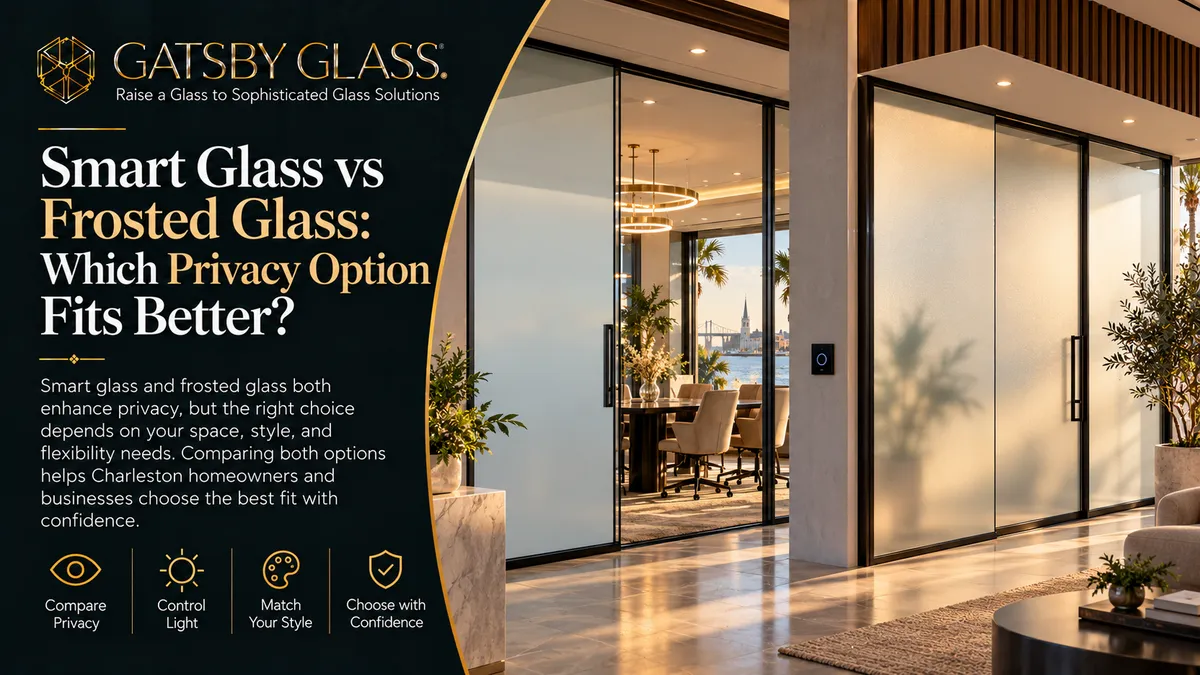
Smart Glass vs Frosted Glass: Which Privacy Option Fits Better in a Charleston Home or Business?
Need privacy without losing light in your Charleston home or office? This honest comparison of smart glass and frosted glass covers cost, performance, maintenance, and which option actually makes sense for each application.
Smart Glass vs Frosted Glass: Which Privacy Option Fits Better in a Charleston Home or Business?
Glass is the material that solves the light problem in almost every modern interior; it lets natural light travel through walls and partitions that would otherwise block it entirely, keeping spaces bright, open, and visually connected in ways that solid construction can’t match.
But glass creates a different problem the moment you need privacy. A clear glass partition between a home office and a living room handles the light perfectly and handles privacy not at all. A glass-walled conference room gives everyone outside the room a complete view of everything happening inside it. A bathroom with a glass window facing a neighbor’s property is only usable after dark.
The answer to this tension how to have the light without the exposure is privacy glass. And for anyone in Charleston currently planning a bathroom renovation, an office buildout, a home office partition, or any application where privacy and light need to coexist, there are two options that come up most consistently in design consultations: frosted glass and smart glass.
They solve the same problem in fundamentally different ways, at fundamentally different price points, with fundamentally different practical implications. If you’ve been comparing them and finding the information scattered or unclear, this guide covers both honestly: what each one actually is, where each one works best, and how to think about which fits your specific situation in the Charleston market.
The conversation starts, as it always should, with the glass walls and partitions or shower enclosure application you’re actually trying to solve because the right privacy glass choice is always specific to the space, not universal.
What Frosted Glass Actually Is
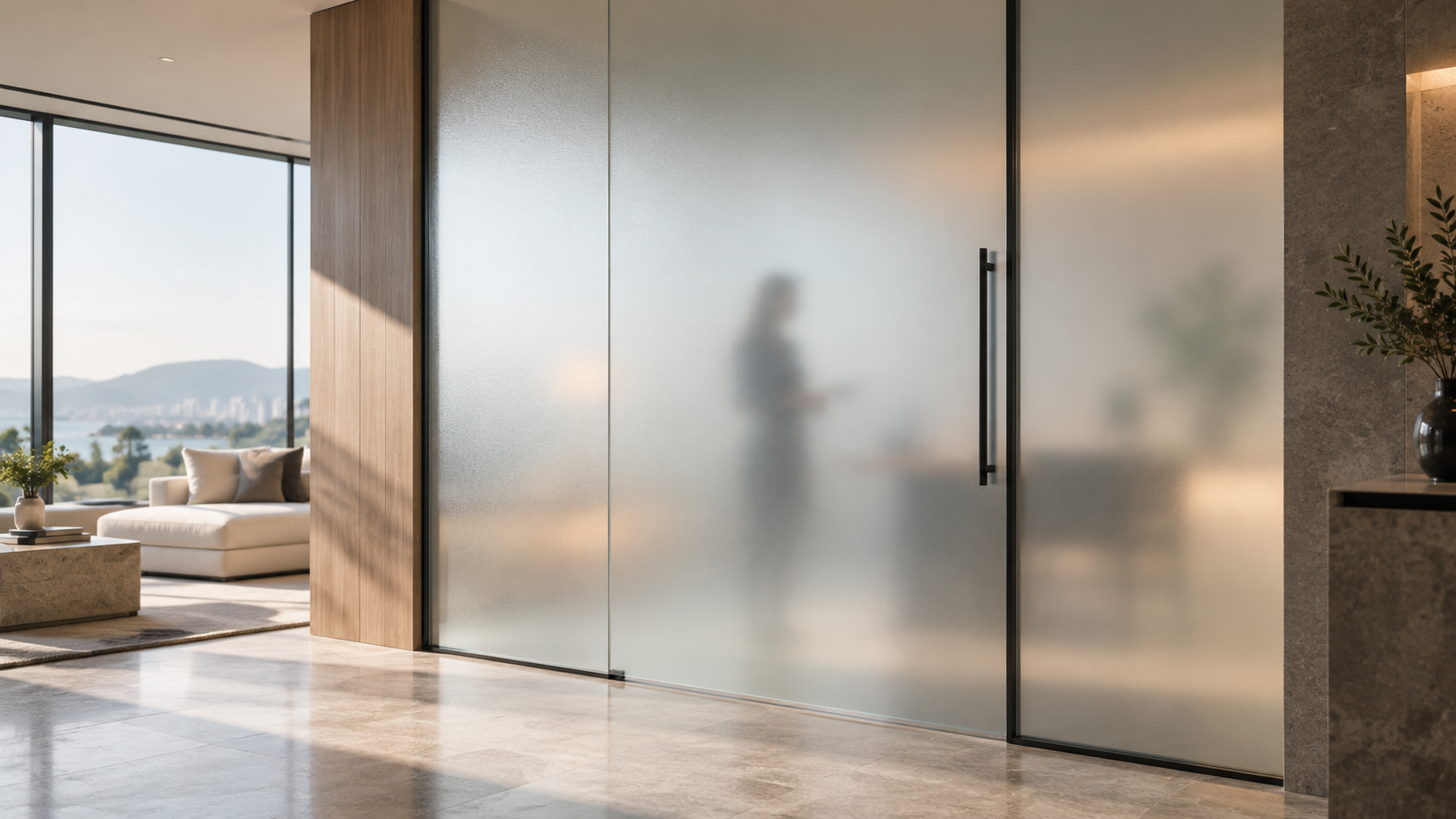
Frosted glass is standard clear glass that has been treated to create a translucent surface, one that transmits light freely but obscures the visual detail of what’s behind it. The frosting can be achieved in two main ways.
Acid-etched frosting uses a chemical process to permanently alter the glass surface, creating a smooth, matte finish that scatters light as it passes through. The result is even, consistent translucency across the full panel surface. Acid-etched glass has a clean, refined quality that suits both residential and commercial applications; it reads as a deliberate design material rather than a practical compromise.
Sandblasted frosting uses abrasive particles to roughen the glass surface. The texture is slightly coarser than acid-etched glass and can be varied in depth and pattern, which allows for decorative effects, gradients, patterns, and text that acid etching doesn’t easily produce. Sandblasted glass tends to have a slightly more tactile surface quality.
Both processes produce glass that is permanently frosted; the privacy level is fixed, the same in every lighting condition and at every time of day, and cannot be adjusted. This permanence is both the strength and the limitation of frosted glass as a privacy solution.
Reeded and textured glass, which includes fluted reeded glass, patterned glass, and other decorative textured options, works on the same principle as frosted glass in that it obscures visual detail while transmitting light. The distinction is that the obscuring mechanism is texture rather than surface diffusion. Reeded glass, in particular, has become increasingly popular in Charleston interiors for its design quality; the vertical fluting adds visual interest that plain frosted glass lacks, and it suits both historic home contexts and contemporary spaces.
What Smart Glass Actually Is
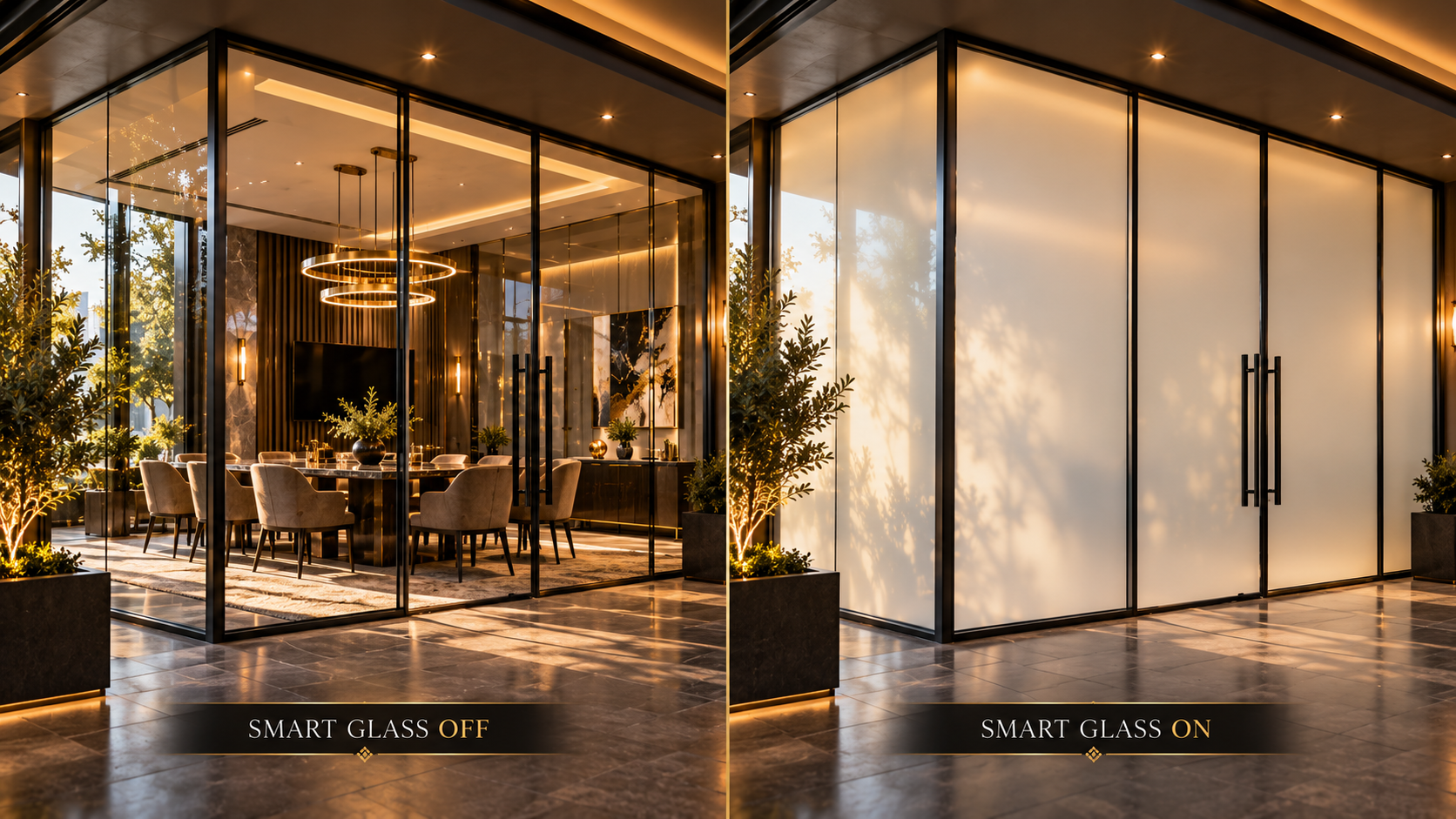
Smart glass, also called switchable glass, electrochromic glass, or privacy glass, is a fundamentally different technology. It uses an electrical current applied to a special interlayer within a laminated glass assembly to switch the glass between transparent and opaque states. In the off state (no current), the interlayer is diffused, and the glass appears frosted, translucent, light-transmitting, and visually private. When current is applied, the interlayer aligns, and the glass becomes clear.
The practical effect is that smart glass gives you a single panel that can be clear when you want it clear and frosted when you want it frosted, switched by a wall control, a remote, a smart home app, or an automated schedule.
This sounds, on paper, like the obvious answer to every privacy glass question. And for specific applications, it genuinely is. But smart glass comes with cost, complexity, and practical considerations that change the calculus significantly for most residential and many commercial situations, and understanding those is essential before treating it as a universal upgrade over frosted glass.
The Cost Difference: What You’re Actually Comparing
This is the dimension of the comparison that most directly shapes the decision for the majority of Charleston homeowners and business owners, and the honest picture is worth stating clearly.
Frosted glass costs modestly more than standard clear glass of the same specification; the acid-etching or sandblasting process adds cost, but not dramatically. For a bathroom shower application, a home office partition, or a conference room partition, the price difference between clear and frosted glass in a frameless shower enclosure or a glass partition is typically a relatively small portion of the total project cost. The frosting is a straightforward specification choice that doesn’t change the installation complexity, the hardware requirements, or the maintenance profile of the system.
Smart glass is a fundamentally different cost story. The laminated smart glass panels themselves cost several times more than equivalent frosted glass per square foot; the technology is sophisticated, and the manufacturing is specialized. Beyond the glass cost, smart glass requires electrical infrastructure: wiring to each panel, a switching mechanism (wall switch, remote, or smart home integration), and a transformer or driver to manage the low-voltage current the glass requires. This electrical work adds installation complexity and cost that frosted glass doesn’t carry.
For a single shower enclosure or a small partition panel, the smart glass premium over frosted glass is substantial in percentage terms. For a large commercial application, a full glass conference room wall or a floor-to-ceiling office partition system, the premium is still significant but spread across a larger panel area, which changes the per-square-foot calculus somewhat.
The practical implication: for most residential applications in Charleston, bathroom showers, home office partitions, bedroom privacy, frosted glass delivers the required outcome at a cost that’s proportionate to a renovation budget. Smart glass in the same applications is a significant luxury premium that needs to be justified by a genuine functional need for switchability, not just a preference for the technology.
The Privacy Performance Comparison
Both options provide genuine visual privacy. But they provide it differently, and the differences matter depending on the application.
Frosted Glass Privacy Performance
Frosted glass provides consistent, permanent visual privacy at all times. In any lighting condition bright midday sun, evening lamp light, morning bathroom light the frosted surface scatters light passing through it and prevents the visual detail on either side from being read clearly. The privacy level doesn’t change with time of day, with the lighting situation, or with any other variable.
One nuance worth knowing: the direction of the light source affects the privacy experience with frosted glass. When the light source is on the same side as the viewer, you’re looking at a frosted panel with the light behind you; the privacy is complete. When the light source is on the opposite side, the person or activity you’re trying to obscure is backlit; the shadow detail of figures and movement can become partially visible through the frosted surface. In a bathroom shower application, for example, a strong light source inside the shower and a dimly lit bathroom outside will create more shadow visibility through frosted glass than the reverse situation.
This is a manageable consideration in most applications; bathroom lighting can be designed to account for it, but it’s worth knowing before the specification is finalized.
Smart Glass Privacy Performance
In the opaque state, smart glass provides privacy comparable to frosted glass; it scatters light and prevents visual detail from reading through the panel. The same directional lighting consideration applies.
In the clear state, smart glass is fully transparent, equivalent in visual performance to standard clear glass. This is the differentiating quality: a single panel that performs as both clear glass and frosted glass depending on the current state.
One practical point: smart glass in its default off state (no current, panel opaque) requires active power to become transparent. This means that in a power outage, smart glass defaults to its opaque state, which is actually the desirable failure mode for most privacy applications. A shower enclosure that becomes opaque when the power goes out is a better failure than one that becomes clear.
The quality of the smart glass technology matters significantly in the privacy performance. Budget smart glass products can have uneven switching areas that clear more slowly than others, a slight haze even in the clear state, and noticeable color shift between states. Quality smart glass products switch cleanly and evenly, are genuinely clear in the transparent state, and have no visible color cast in either state. For applications where the clear state is important, such as an office partition that needs to communicate openness and visual connection when not in privacy mode, the quality of the clear state is as important as the quality of the opaque state.
Application by Application: Which One Fits Where
Bathroom Shower Enclosures
For most Charleston bathroom renovations, frosted glass is the practical answer for shower privacy applications where visual privacy is needed.
A frameless shower enclosure with frosted or reeded glass panels provides complete, consistent visual privacy throughout every shower, in every lighting condition, without any electrical infrastructure, without any ongoing energy consumption, without any maintenance complexity beyond standard glass cleaning.
Smart glass in a shower enclosure is technically feasible; the panels need to be rated for the wet environment, which is an additional specification consideration, and there are high-end residential applications where the ability to switch between a clear view into the shower and full privacy has genuine appeal. But for most Charleston bathroom renovations, the premium for that switchability is difficult to justify when frosted glass provides the privacy consistently and reliably at a fraction of the cost.
The exception is a master bathroom where the clear state of smart glass has specific design value, a bathroom where the shower is visible from a freestanding tub or a seating area, where the homeowner wants to enjoy the tile and the space visually when the shower isn’t in use but have complete privacy when it is. In that specific scenario, the switchability adds functional value rather than just technological novelty.
Home Office Glass Partitions
This is the application where the smart glass vs. frosted glass conversation becomes genuinely interesting because the functional requirements of a home office partition include both states at different times.
A home office partition needs to be transparent during the workday; the visual connection to the household, the sense of being present rather than closed off, the ambient awareness that makes working from home feel like part of family life rather than exile from it are all values that the clear state of a glass partition serves. And it needs to be private during video calls, focused client work, or any period when visual exposure to the household is a distraction or a confidentiality concern.
Frosted glass provides privacy consistently but sacrifices the clear state entirely; the partition is always frosted, always private, always visually present as an obscuring element rather than a transparent one. For homeowners who specifically want the visual openness of a clear glass partition during most of their working day and privacy on demand during calls, smart glass is the functional answer rather than a luxury.
The question is whether that on-demand privacy is worth the smart glass premium compared to alternatives: a clear glass partition with a simple window film that can be applied when needed, or a clear glass partition with a well-positioned camera angle that keeps the background appropriate for calls without requiring visual privacy of the whole partition. For many homeowners, these alternatives handle the practical concern at a fraction of the smart glass cost. For homeowners with high daily call volume, sensitive client work, or a household environment that makes visual privacy a genuine ongoing need rather than an occasional one, smart glass’s switchability has real functional value.
Commercial Office Conference Rooms
This is arguably the strongest residential-to-commercial case for smart glass, and it’s where the technology is most widely deployed in Charleston’s higher-end commercial office installations.
A glass-walled conference room serves two distinct functions at different times: it’s a meeting room when in use, requiring visual privacy for sensitive discussions; and it’s a transparent element of the office floor plate when empty, contributing to the open, light-filled quality that well-designed glass office partitions create. Frosted glass provides the privacy but sacrifices the open quality. Clear glass provides the open quality but requires blinds or window film for privacy during meetings, which means manual operation, inconsistent use, and the visual mess of partially drawn blinds on what should be a clean glass surface.
Smart glass solves this elegantly. The conference room is visually clear part of the open office, contributing to the floor plate’s light and visual connectivity until a meeting begins, at which point the glass switches to opaque with a single control interaction. The transition takes a few seconds. The meeting ends, the glass clears, and the conference room disappears back into the floor plate as a transparent element.
Emily R. from Downtown Charleston described the core tension this solves: “We needed a conference room without losing the natural light. The glass gives us a real room, but the office still feels open instead of chopped up.” In a smart glass conference room, that quality of a real room that doesn’t chop up the office is available both when the room is in use and when it isn’t, switching between the two states on demand.
For commercial offices where conference room privacy is needed multiple times daily and where the clear state’s contribution to the office environment is a genuine design priority, the smart glass premium is easier to justify than in residential applications.
Medical and Healthcare Office Partitions
Healthcare applications consultation rooms, examination areas, therapy spaces have the most straightforward case for smart glass of any application category. The functional requirement is absolute: complete visual privacy when a patient is present, complete transparency when the space is empty or being prepared.
Frosted glass handles the privacy requirement but creates a consultation room that reads as permanently closed off a solid-looking space that doesn’t contribute to the open, welcoming quality of the clinical environment when not in use. Smart glass handles both states: an open, transparent consultation space that becomes completely private with a single control interaction when the patient arrives.
For medical practices in Charleston’s growing healthcare real estate market the office parks of Mount Pleasant, the medical corridor near MUSC on the Charleston peninsula, and the expanding healthcare facilities in North Charleston, smart glass consultation rooms are an investment in both the patient experience and the operational flow of the practice.
Residential Interior Windows and Sidelights
Historic Charleston homes frequently have interior windows, borrowed-light openings between rooms, sidelights beside interior doors, and transoms above doorways that were originally designed to let light move through the house’s interior without creating full visual exposure between rooms.
For these applications, frosted glass is almost always the right specification. The privacy need is consistent: the interior window should always obscure the adjacent room to the desired degree, and the permanence of frosted glass suits an architectural element that functions as a fixed part of the room’s design rather than a variable one. Reeded glass in particular is historically resonant in these applications; it was used in exactly this way in Victorian and Edwardian-era homes, and installing it in a historic Charleston home’s interior windows feels like a restoration of the original design intention rather than a contemporary imposition.
The Maintenance Comparison
This dimension of the comparison consistently surprises people, so it’s worth being direct about it.
Frosted glass maintenance is identical to standard glass maintenance: wipe it down with appropriate glass cleaner, keep it dry between uses in wet environments, inspect sealant annually in shower applications. The frosted surface doesn’t require any special cleaning product or technique. In Charleston’s coastal humidity, the same routine that serves clear glass serves frosted glass equally.
One nuance: the textured surface of sandblasted frosted glass can accumulate soap scum and mineral deposits in the microscopic roughness of the surface texture, which can be harder to remove than deposits on a smooth glass surface. Acid-etched frosted glass has a smoother surface that cleans more easily. In shower applications specifically, acid-etched over sandblasted is the lower-maintenance specification.
Smart glass maintenance is more involved, not dramatically, but meaningfully. The electrical components require periodic inspection. The panels themselves clean like standard glass on the surface, but any issue with the interlayer bubbling, delamination, or uneven switching is an internal problem that can’t be addressed through surface maintenance. It requires panel replacement, which at smart glass costs is a meaningful remediation expense.
In Charleston’s coastal humidity environment, the long-term durability of the smart glass interlayer in consistently high-humidity applications, especially showers, is worth discussing explicitly during the specification conversation. Quality smart glass products designed for wet environments handle the humidity adequately, but budget products may not maintain their switching performance consistently over years of high-humidity exposure.
Mixed Approaches: Using Both in the Same Project
The privacy glass conversation in a Charleston home or commercial space doesn’t have to resolve entirely to one option. Many well-designed projects use both frosted and smart glass, matching each to the application where it fits best.
A home office partition in smart glass switchable for the visual flexibility a home office genuinely needs, paired with frosted reeded glass in the adjacent bathroom shower, where consistent permanent privacy is the right specification. A commercial office with smart glass conference rooms where the switchability justifies the premium and frosted glass in the permanent partition elements where the clear state adds no functional value.
This kind of calibrated approach, rather than a binary all-smart or all-frosted decision, produces the best functional and cost outcome for most Charleston projects where privacy glass is part of a larger design scope.
What to Discuss During the Consultation
Before specifying either option for any application, a few questions are worth getting clear answers to.
Do you need the clear state, or just the private state? If the application only ever needs to be a private shower, a permanent interior divider, a fixed sidelight frosted glass is the right answer, and the smart glass premium adds no functional value. If the application genuinely benefits from switching between transparent and opaque at different times a conference room, a home office partition, a medical consultation room smart glass’s switchability is functional rather than merely impressive.
What is the lighting situation on both sides of the glass? The directional lighting effect on frosted glass privacy is worth mapping for the specific application before the specification is finalized. A simple site assessment during the consultation covers this adequately.
What is the power infrastructure situation? Smart glass requires electrical infrastructure at every panel. In a renovation context, the cost and disruption of adding that infrastructure running wiring, installing a driver, and integrating with existing electrical systems can be significant and should be factored into the total project cost from the beginning.
What is the long-term maintenance commitment? For commercial applications with high use frequency, or residential applications in high-humidity environments, the long-term maintenance and potential replacement cost of smart glass is worth understanding upfront rather than discovering after installation.
The Bottom Line for Charleston Homes and Businesses
Frosted glass, including reeded and textured variants, is the right privacy glass specification for the majority of Charleston residential and commercial applications. It provides reliable, permanent, consistent visual privacy while transmitting light freely. It installs as part of any standard glass project without additional infrastructure. It is maintained as simply as clear glass. And in the Charleston coastal environment, its durability profile is straightforward and well-understood.
Smart glass is the right specification for specific applications where switchability is a genuine functional requirement rather than a preference: commercial conference rooms with heavy daily use, medical consultation spaces, home office partitions in households where the clear state has real daily value, and high-end residential applications where the technology justifies the premium. In those specific contexts, smart glass solves a problem that frosted glass cannot.
The team at Gatsby Glass of Charleston can help you think through this decision for your specific application, whether you’re considering privacy glass for a shower enclosure, a home office partition, a commercial conference room, or any other space where light and privacy need to coexist. The right answer is always specific to the space, and a consultation focused on your actual functional requirements is the most direct path to making the right call.
Reach out to schedule your free design consultation. Come with photos, a description of the application, and a clear sense of when you need privacy and when you want openness. Leave with a specific recommendation on which privacy glass option fits your space, your use pattern, and your budget in Charleston’s market.
Gatsby Glass of Charleston serves homeowners and businesses across Charleston, Mount Pleasant, Summerville, West Ashley, North Charleston, James Island, Folly Beach, Isle of Palms, Daniel Island, and surrounding South Carolina Lowcountry areas. Call (843) 350-5141 or visit gatsbyglasscharleston.com to schedule your free consultation.