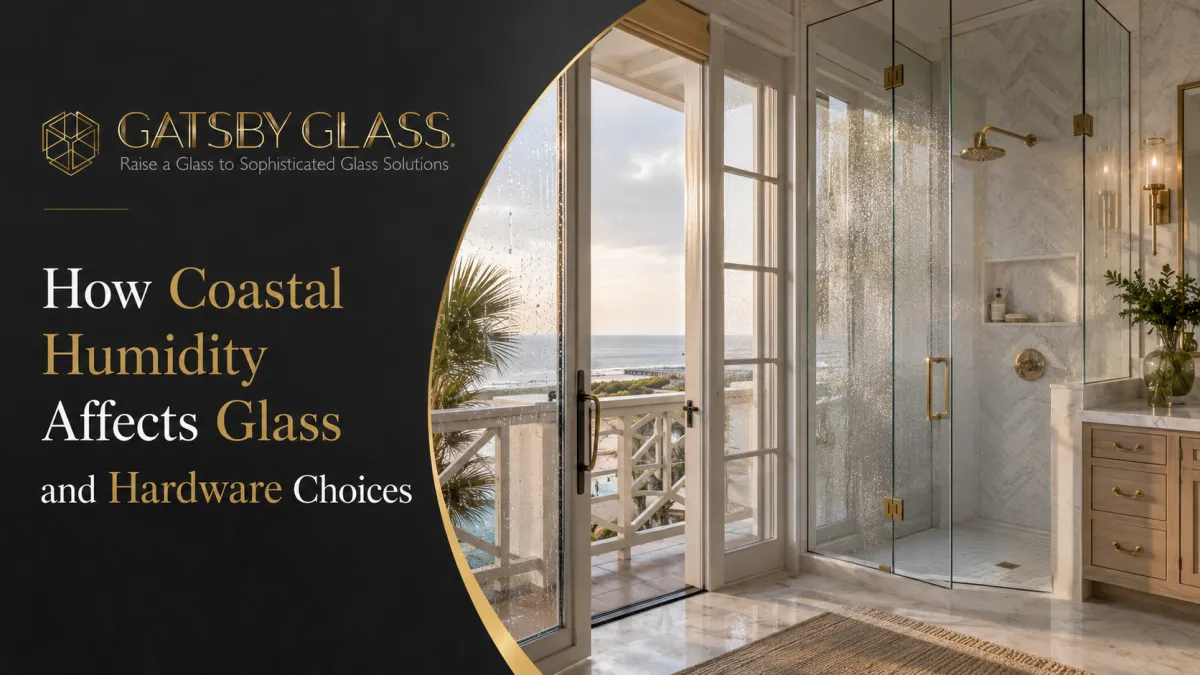
How Coastal Humidity Affects Glass and Hardware Choices in Charleston
Living near the water in Charleston means your glass installations face salt air, high humidity, and intense UV exposure year-round. Here's exactly what that means for the materials and hardware you should and shouldn't be choosing.
How Coastal Humidity Affects Glass and Hardware Choices in Charleston
Most people shopping for glass upgrades, a new shower enclosure, a railing system, a set of mirrors, or an office partition are thinking about aesthetics first and durability second. That's natural. The visual transformation is what draws people in, and it's what they imagine when they're planning a renovation.
But in Charleston, there's a third consideration that deserves just as much attention as the other two: the environment. And if you've lived on the South Carolina coast for any length of time, you already know why.
The combination of salt air, persistent humidity, intense summer UV exposure, and the occasional tropical weather event that moves through the Lowcountry creates one of the most demanding environments on the entire East Coast for building materials, glass installations included. The good news is that when custom glass solutions are specified correctly for this environment, they perform exceptionally well and hold up for decades without significant deterioration. The bad news is that when they're specified incorrectly wrong hardware grade, wrong sealing approach, wrong glass coating the coastal environment finds the weakness quickly and makes it worse in a hurry.
This guide is about helping you understand exactly what's happening to glass and hardware in the Charleston coastal climate, what the right choices look like, and what questions to ask before any glass installation on your property. Whether you're considering a bathroom renovation in Mount Pleasant, a railing upgrade on a Folly Beach deck, or a commercial glass buildout in downtown Charleston, the material principles here apply directly to your project.
What the Charleston Coastal Climate Actually Does to Building Materials
Let's start with the environment itself, because understanding the specific stressors helps everything else make sense.
Salt Air and Chloride Corrosion
The primary threat to glass hardware in a coastal environment isn't humidity in isolation — it's salt. Airborne sodium chloride particles, carried inland from the ocean by prevailing winds and deposited on every exposed surface, are extraordinarily corrosive to metal. The mechanism is electrochemical: chloride ions penetrate the oxide layer that forms naturally on metal surfaces and accelerate the oxidation process dramatically. What would take years to develop inland can appear in months within proximity to the ocean.
The severity of salt exposure isn't uniform across the Charleston area. A home directly on the ocean at Sullivan's Island or the front row of Isle of Palms faces constant, heavy salt spray, a fundamentally different exposure profile than a home in Summerville or even one several miles inland from the water in West Ashley. Understanding where your property sits on that spectrum is genuinely relevant to hardware specification decisions.
Humidity and Moisture Cycling
Charleston's average relative humidity sits above 70% for most of the year and regularly pushes into the 80s and 90s during summer months. This persistent moisture creates two problems for glass installations. First, it accelerates corrosion on any metal hardware that isn't properly specified or coated. Moisture is the medium in which salt-driven corrosion occurs most aggressively. Second, repeated cycles of high humidity followed by lower humidity cause expansion and contraction in materials, including the sealants and gaskets used in glass installations, that can degrade their integrity over time if the wrong products are used.
For interior applications, bathrooms, shower enclosures, and interior mirrors, the humidity concern is compounded by the direct moisture exposure of daily use. A bathroom in a coastal Charleston home is running both the ambient coastal humidity and the localized steam environment of showers and baths simultaneously. Installations that handle one of those stressors but not the other tend to show deterioration faster than homeowners expect.
UV Exposure and Heat Load
Charleston sits at roughly 33 degrees north latitude and receives intense solar radiation throughout the extended summer season. UV exposure affects glass installations in two ways. First, it degrades certain coatings and sealants more rapidly than in northern climates; products that are rated for ten years of UV exposure in Boston may need replacement in six or seven years in Charleston. Second, intense solar heat load causes thermal expansion in glass panels, which creates stress at the edges and mounting points if the installation doesn't account for adequate expansion tolerance. This is a less commonly discussed issue, but one that experienced local installers understand and build into their approach.
How the Coastal Environment Affects the Glass Itself
Here's where most people are surprised: the glass panels themselves are actually the most durable component of any glass installation in a coastal environment. Tempered safety glass, laminated glass, and tempered-laminated glass are essentially impervious to salt air, humidity, and UV radiation under normal conditions. Glass doesn't rust, doesn't oxidize, doesn't warp, and doesn't degrade from salt exposure. Left entirely unmaintained, the worst outcome for glass in a coastal environment is surface etching from accumulated salt residue, a purely cosmetic issue that's entirely preventable with periodic fresh-water rinsing.
This is worth stating clearly because it's counterintuitive to many homeowners who assume that the glass itself is the vulnerability. It isn't. The glass is the easy part.
Where things get more complicated, and where material choices genuinely matter, is the hardware, the sealants, the coatings, and the mounting systems that hold the glass in place and integrate it into the building.
The Hardware Question: Where Coastal Specifications Really Matter
Stainless Steel — But Not All Stainless Steel Is Equal
Stainless steel is the baseline specification for glass hardware in any coastal environment. It resists corrosion through the formation of a chromium oxide passive layer that protects the underlying metal from oxidation. But here's what most homeowners, and some contractors, don't know: there are multiple grades of stainless steel, and the difference between them is significant in a salt-air environment.
304-grade stainless steel is the most common grade used in interior applications, hinges, handles, towel bars, and kitchen fixtures. It contains approximately 18% chromium and 8% nickel and offers good corrosion resistance in most environments. Indoors, away from direct salt exposure, it performs well for decades.
316-grade stainless steel adds molybdenum, typically 2-3%, to the alloy. This addition specifically targets chloride corrosion resistance, which is exactly the corrosion mechanism that salt air drives. In coastal environments with meaningful salt exposure, 316-grade stainless is dramatically more resistant to the pitting and surface corrosion that eventually degrade 304-grade hardware.
For frameless shower enclosures in any Charleston home, 316-grade hardware on the hinges, handles, and wall mounts is a worthwhile specification, not because 304-grade will fail immediately, but because the bathroom environment combines salt-air exposure with direct water contact and steam, and 316-grade handles that combination significantly better over the long term.
For exterior applications, glass railings on decks, balconies, and piazzas, 316-grade stainless is not optional on any property with meaningful coastal exposure. It is the minimum appropriate specification. Any contractor proposing 304-grade hardware on an oceanfront or near-water exterior installation is either unaware of the difference or cutting costs in a way that will become visible within a few years.
Aluminum Hardware — Where It Works and Where It Doesn't
Aluminum is widely used in glass framing systems, shower door frames, sliding door tracks, window frames, and storefront systems because it's lightweight, economical, and naturally forms an oxide layer that provides some corrosion resistance. In moderate environments, it performs adequately for many years.
In coastal Charleston, aluminum hardware requires more careful evaluation. Uncoated aluminum in a salt-air environment develops a white, powdery oxidation, aluminum oxide, that is cosmetically unappealing and can eventually compromise the integrity of tracks and hinges if left unaddressed. Anodized or powder-coated aluminum performs substantially better, as the coating creates a barrier between the base metal and the salt-laden atmosphere.
This is one reason why the shift toward frameless glass systems, which use minimal hardware, typically of higher-grade stainless steel, has been so consistent in coastal markets. Frameless shower enclosures and frameless railing systems simply have less hardware exposed to the environment, and what hardware they do use is typically specified at a higher grade than equivalent framed systems. Less metal surface area in contact with coastal air means fewer points of potential failure.
Brass and Bronze Hardware
Solid brass and bronze hardware, used in some premium shower enclosures, custom mirror frames, and architectural glass applications, develops a natural patina in coastal environments that many homeowners find beautiful rather than objectionable. The patina is a surface oxidation product that actually protects the underlying metal from deeper corrosion. Properly finished brass and bronze hardware can be highly durable in coastal applications.
The caveat is consistency. Plated brass, a base metal with a thin brass coating, behaves very differently from solid brass in a coastal environment. The plating eventually fails, exposing the base metal underneath to direct salt-air exposure with accelerated results. If you're specifying brass or bronze hardware for a coastal installation, solid material rather than plated is the appropriate choice.
Sealants, Gaskets, and Edge Treatments
Hardware gets most of the attention in coastal glass installation conversations, but sealants deserve equal consideration, particularly for shower enclosures and any installation where glass meets a wall, floor, or substrate.
Silicone sealant is the standard for glass installation sealing across the industry, and for good reason, it remains flexible through temperature cycling, bonds well to glass and most substrates, and resists moisture penetration when properly applied. But not all silicone sealants are created equal in terms of mold and mildew resistance, UV stability, and longevity in high-humidity environments.
For Charleston bathrooms specifically, 100% silicone sealant, not silicone blend or latex caulk, with an antimicrobial additive, is the appropriate specification. The antimicrobial component inhibits the mold growth that the coastal humidity environment actively encourages. Standard silicone without this feature will eventually show mold staining in the bead, particularly in areas of the shower enclosure that don't dry completely between uses.
Edge polishing and treatment of glass panels also matter more in coastal environments than many installers acknowledge. Micro-chips and rough edges on glass panels create nucleation points where moisture can begin to penetrate, an issue that's negligible in dry climates but meaningful in an environment where humidity is persistent. Properly polished and treated edges on custom mirrors and glass panels are not a cosmetic luxury in Charleston; they're a durability measure.
Glass Coatings That Make a Real Difference
The glass industry has developed several surface coatings that meaningfully improve the performance and maintenance requirements of glass in demanding environments. Two are particularly relevant to coastal Charleston applications.
Hydrophobic Coatings
Hydrophobic glass coatings, sometimes marketed under brand names like ClearShield, EnduroShield, or similar, chemically bond to the glass surface and cause water to bead and sheet off rather than spreading across the surface and evaporating to leave mineral deposits. In a coastal environment where the water itself carries dissolved salts and minerals, hydrophobic coatings dramatically reduce the rate at which salt residue accumulates on glass surfaces.
For exterior glass, railing panels on oceanfront decks, storefront glass facing salt-laden sea breezes, a hydrophobic coating can meaningfully extend the interval between cleanings and reduce the risk of permanent etching from accumulated salt deposits. For interior shower glass, the same coating reduces soap scum and mineral deposit buildup, making cleaning faster and less frequent.
These coatings do eventually wear; typical service life is five to ten years, depending on exposure and maintenance, and should be refreshed when water no longer beads aggressively on the surface. But as a built-in feature of a new glass installation in coastal Charleston, they represent genuinely good value.
Low-Iron Glass for Clarity in Coastal Light
Standard float glass has a slight green tint caused by iron content in the manufacturing process. This tint is largely invisible in small panels but becomes progressively more apparent in larger glass installations, particularly in glass walls and partitions and full-wall mirror applications where you're looking through significant glass thickness.
Low-iron glass, sometimes called ultra-clear or starphire glass, has a dramatically reduced iron content that eliminates the green tint and produces a near-colorless transparency. In the warm, golden coastal light that Charleston gets in the mornings and late afternoons, low-iron glass has a quality of clarity and luminosity that standard glass simply doesn't match. For high-visibility applications, large custom mirrors, prominent glass partitions, and statement railing panels, the upgrade to low-iron glass is worth serious consideration.
Practical Maintenance in the Coastal Environment
Even with correctly specified materials, coastal glass installations benefit from a consistent and simple maintenance routine. Here's what actually matters.
Fresh water rinsing for exterior glass. Salt residue accumulates on any exterior glass surface exposed to coastal air — railing panels, storefront glass, exterior windows adjacent to glass installations. A thorough rinse with fresh water after significant weather events and on a monthly basis during the high-exposure summer season prevents the salt from etching permanently into the surface. This is a ten-minute task with a garden hose, and it makes a genuine difference over the long term.
Squeegee discipline for shower glass. Running a squeegee across shower glass after each use is the single most effective maintenance habit for keeping frameless shower enclosures looking pristine in a humid coastal environment. It removes water before it can evaporate and leave mineral deposits, dramatically slowing the rate of buildup that eventually requires more aggressive cleaning. It takes thirty seconds.
Annual hardware inspection: Once a year, or after any significant storm event, a visual inspection of all glass hardware is worthwhile. You're looking for early signs of surface corrosion, checking that screws and fasteners are tight, examining sealant beads for cracking or separation, and noting any points where water may be getting behind glass panels rather than sheeting off them. Catching these issues early is always less expensive than addressing them after they've progressed.
Periodic professional cleaning for mirrors: Custom mirrors in coastal homes benefit from professional cleaning once or twice a year, particularly large-format installations in bathrooms or entrance halls where the backing is exposed to persistent humidity. Professional cleaning removes buildup that household products don't fully address and allows for inspection of the mirror backing for any early signs of moisture penetration at the edges.
The Difference a Local Expert Makes
All of this material knowledge, hardware grades, sealant specifications, glass coatings, and maintenance protocols is only as useful as the person applying it to your specific project. And this is where working with a genuinely local glass professional makes a meaningful, practical difference.
A glass company that operates primarily in a dry inland market doesn't encounter the salt-air hardware failure mode regularly enough to have internalized the specification choices that prevent it. They may not stock 316-grade hardware as standard. They may not have experience with hydrophobic coatings. They may not know the specific humidity behavior of different neighborhoods in the Charleston area, the difference between a property on the front beach at Folly and one in the interior of Johns Island, which should inform specification decisions.
The team at Gatsby Glass of Charleston works in this environment every day. The specifications they bring to a project hardware grades, sealant selections, and glass treatments reflect years of experience watching what holds up in coastal Charleston and what doesn't. That local material knowledge is embedded in every installation recommendation they make, from a single shower enclosure to a full commercial glass buildout.
Questions to Ask Before Any Glass Installation in Coastal Charleston
Whether you're working with Gatsby Glass or any other glass professional in the area, these are the questions that will tell you whether the person you're talking to understands the coastal environment or is just applying standard specifications that may not be right for your property.
What grade of stainless steel are you using for the hardware?
The answer for any exterior or high-humidity application should be 316-grade. If the answer is simply "stainless steel" without a grade specification, that's a conversation worth having in more detail.
What sealant are you using, and does it have antimicrobial properties?
For shower enclosures and bathroom applications in a coastal climate, the sealant specification matters. 100% silicone with an antimicrobial additive is the appropriate answer.
Do you recommend a hydrophobic coating for this application?
A knowledgeable local installer will have a clear opinion on whether a hydrophobic coating is appropriate for your specific project and why.
How are the glass edges finished?
Polished edges on all glass panels, not just ground or seamed, are the appropriate finish for a quality installation in a high-humidity environment.
What maintenance does this installation require in a coastal environment?
Any experienced coastal installer should be able to give you a clear, practical answer to this question. If the answer is "none," that's worth probing further.
The Bottom Line for Charleston Homeowners and Business Owners
The coastal environment here is genuinely demanding, but it doesn't make quality glass installations impossible. It makes material specification more important. The right glass, the right hardware grade, the right sealants, the right coatings, and a simple maintenance routine will produce glass installations that look beautiful and perform reliably for decades in the Lowcountry climate.
The wrong specifications, generic hardware, standard sealants, and no coating consideration will show the effects of the coastal environment within a few years and require premature replacement or repair. The cost difference between getting it right and getting it wrong is usually modest at the time of installation and significant over the life of the product.
If you're planning any glass installation, frameless shower enclosures, glass railings, mirrors, partitions, or commercial glass on a Charleston-area property, the conversation about material specification for the coastal environment should happen before any glass is ordered. It's much easier to get it right at the beginning than to correct it after the fact.
Reach out to Gatsby Glass of Charleston to schedule your free design consultation. Their team will assess your specific property, understand the exposure profile of your location, and recommend the right materials from the start — so your investment holds up the way it should in the environment it's actually living in.
Gatsby Glass of Charleston serves homeowners and businesses across Charleston, Mount Pleasant, Summerville, West Ashley, James Island, Folly Beach, Isle of Palms, Sullivan's Island, and surrounding South Carolina areas. Call (843) 350-5141 or visit gatsbyglasscharleston.com to schedule your free consultation.