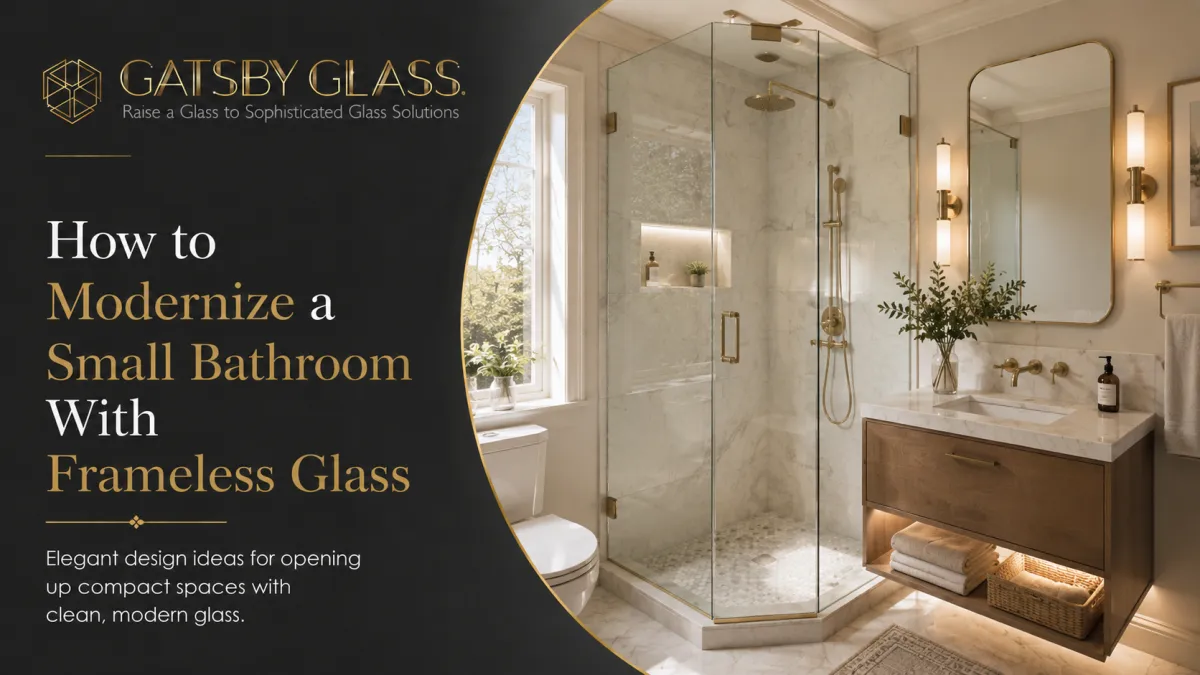
How to Modernize a Small Bathroom With Frameless Glass
Small bathroom feeling outdated and cramped? Discover how frameless glass, from showers to mirrors, can modernize the space and make it feel dramatically larger, without a full renovation.
There's a specific kind of bathroom that exists in an enormous number of Charleston homes, historic and modern alike. It's not poorly designed, exactly. It's just small. A footprint shaped by decades-old plumbing lines, a tub-shower combo that's seen better days, a vanity that barely leaves room to turn around, and a shower curtain or a clunky framed door that makes the whole room feel even tighter than it already is.
If you've stood in a bathroom like that and thought, "this room could feel so much better if it just felt bigger," you're closer to a solution than you might realize. A full renovation moving plumbing, expanding the footprint, knocking down a wall is one path, and sometimes it's the right one. But for a huge number of small Charleston bathrooms, the most effective transformation doesn't require any of that.
It requires frameless glass.
Frameless shower enclosures and frameless custom mirrors are, square foot for square foot, two of the highest-impact upgrades available for a small bathroom. Neither one changes the room's actual dimensions. Both change how the room feels in a way that's genuinely dramatic. And understanding exactly why that works — and how to apply it correctly to your specific space is the difference between a bathroom upgrade that feels like a minor improvement and one that feels like an entirely new room.
Why Small Bathrooms Feel Smaller Than They Are
Before getting into the glass solutions themselves, it's worth understanding the actual mechanics of why small bathrooms feel cramped, because the answer isn't always simply "it's small."
A lot of what makes a bathroom feel tight is visual interruption. Framed shower doors with thick aluminum channels create a hard visual boundary that chops the room into segments. The shower is its own enclosed box, separate from the rest of the space, and your eye reads the room as smaller than its actual square footage because it's processing multiple separate zones rather than one continuous one.
Opaque shower curtains do something similar but worse; they create a solid visual wall that blocks an entire portion of the room from view, making the remaining visible space feel like the entirety of the room. A small, undersized mirror compounds the problem by failing to do the one thing mirrors are uniquely good at: multiplying light and visually extending the room.
Add in dim or poorly positioned lighting, dark grout lines, and a vanity with limited counter space, and you get the cumulative feeling that defines so many small bathrooms: functional, but claustrophobic. The good news is that almost everything on that list can be addressed without touching plumbing or knocking down a single wall.
Frameless Shower Enclosures: The Single Biggest Visual Change
If you make only one change to a small bathroom, this is almost always the right one. A frameless shower enclosure replaces the segmented, boxed-in feeling of a framed shower door with a continuous, uninterrupted glass surface that lets your eye travel the full length of the room without stopping.
How It Works Visually
The mechanism here is simple but powerful. Without a metal frame breaking up the glass into panels, and without the thick aluminum tracks along the floor and ceiling, the shower enclosure essentially disappears as a separate visual object. The eye reads the full floor-to-ceiling height of the bathroom continuously, rather than stopping at the top edge of a framed door. The tile inside the shower remains visible and becomes part of the overall visual composition of the room rather than being hidden behind an opaque barrier.
For small bathrooms specifically, this matters enormously. In a tight footprint, every visual boundary reads as a wall, even when it's actually transparent. Removing the framing removes the wall, even though the glass itself is still there, doing its job of keeping water contained.
Practical Considerations for Small Spaces
A few specific details matter more in small bathroom applications than in larger ones.
Glass thickness and clarity: Standard 3/8-inch tempered glass is generally sufficient for most residential shower enclosures, though larger openings may call for 1/2-inch glass for added rigidity. For small bathrooms where the shower glass is doing significant visual work, low-iron glass, which eliminates the slight green tint of standard glass, is worth the modest upgrade. In a small, often poorly lit bathroom, that extra clarity makes a noticeable difference in how bright and open the space feels.
Hardware minimalism: The fewer visible hardware elements, the better the visual effect in a tight space. Frameless systems with minimal clips, a single set of hinges, and a slim handle keep the glass as visually uninterrupted as possible. This is one area where it's worth discussing options with your installer; some configurations use even less hardware than others.
Door configuration: In a tight footprint, the swing radius of a hinged door matters practically as well as visually. Sliding frameless doors, pivot doors with a smaller swing arc, or even a fixed glass panel with an open entry (for walk-in shower configurations) can be the right call depending on the exact dimensions of your bathroom. This is a conversation worth having early, because the wrong door configuration in a tight space creates daily friction even if it looks great.
Custom Mirrors: The Underused Multiplier
If the frameless shower enclosure is the most visually dramatic change, the custom mirror is the most underrated one. Most small bathrooms have a mirror that's noticeably smaller than the vanity beneath it — a leftover from a previous renovation or a builder-grade default that was never reconsidered.
A custom mirror sized correctly for a small bathroom does something that a standard mirror simply can't: it maximizes the amount of light being reflected and multiplied within the room, which is the single most effective way to make a small space feel larger.
Sizing Strategy for Small Bathrooms
The general principle for small bathroom mirrors is to go as large as the wall, and the fixtures allow extending edge to edge across the vanity width, and rising as close to the ceiling as practical, given any soffit, light fixture, or trim constraints. A mirror that fills the available wall space reflects significantly more of the room's light and visual depth than a smaller, centered mirror with visible wall space on either side.
For very tight bathrooms, the kind where the vanity is wedged into a corner, or the wall opposite the mirror is just a few feet away, an oversized mirror can make a genuinely startling difference. The reflected depth effectively shows you a version of the room that appears to continue beyond the actual wall, and the brain processes that reflected space as part of the room's total volume.
Frameless vs. Framed Mirrors
A frameless custom mirror, with polished edges and no surrounding frame, tends to work best in small, contemporary bathroom designs because it avoids adding any additional visual weight to the wall. The mirror simply becomes part of the wall surface itself, interrupted only by its own reflective quality.
For bathrooms with more traditional or historic character, common in many Charleston homes, a thin, simple frame in a finish that complements the room's hardware can work beautifully too, as long as the frame stays proportionally light rather than chunky. The goal in either case is the same: to maximize reflected light and depth without adding visual bulk.
Combining the Two: Why Shower Glass and Mirrors Work Together
The most dramatic small bathroom transformations happen when frameless shower glass and a properly sized custom mirror are designed together rather than as separate decisions.
Here's why that combination is so effective. The frameless shower glass eliminates one major visual boundary in the room. The oversized custom mirror reflects and multiplies whatever light is available, and crucially, it also reflects the now-unobstructed shower area, extending the perceived depth of the room even further. Light bounces between the two glass surfaces, and the cumulative effect is a bathroom that reads as substantially larger than its actual measurements.
This is the same principle that makes glass walls and partitions so effective in larger interior design contexts, transparency and reflection working together to eliminate the visual boundaries that make a space feel confined. In a small bathroom, where every square foot matters disproportionately, this combination has an outsized impact relative to its cost.
What Else to Consider While You're Modernizing
A frameless shower and custom mirror are the two highest-impact glass upgrades for a small bathroom, but a few complementary decisions amplify the effect even further if you're already planning the work.
Lighting: Glass surfaces only multiply the available light. If your small bathroom is under-lit, even the best frameless shower and mirror combination will underperform. Layering in a well-placed vanity light at the mirror, supplemented by overhead lighting that reaches into the shower itself, ensures the glass has enough light to actually do its job.
Wall color and tile: Lighter wall colors and lighter grout lines reduce visual weight and complement the openness that frameless glass creates. A small bathroom with dark tile and dark grout fights against the brightening effect of the glass upgrades, even when the glass itself is perfect.
Fixture finish consistency: Coordinating the finish of your shower hardware with your mirror hardware (if framed) and your other bathroom fixtures creates a cohesive look that reads as intentional rather than piecemeal. This is a small detail, but it's the kind of thing that distinguishes a genuinely well-designed small bathroom from one that just has nice individual components.
What This Looks Like in a Real Charleston Bathroom
A common scenario we see across Charleston, in everything from West Ashley ranch homes to compact upstairs bathrooms in historic downtown properties, involves a bathroom in the 35 to 50 square foot range with a tub-shower combo, a standard builder-grade mirror, and dated framed glass or a shower curtain.
The transformation typically involves converting the tub-shower into a walk-in shower with a frameless glass enclosure sized precisely to the available footprint, replacing the undersized mirror with a custom piece that spans the full vanity width and rises close to the ceiling, and updating the lighting to support both. The plumbing stays largely where it was. The footprint doesn't change. But the bathroom that emerges photographs and feels like a different room entirely, brighter, more open, and significantly more in keeping with the rest of a modern home renovation, even in a space that's just a few feet wider than a hallway closet.
This is the kind of project that doesn't require the time, expense, or disruption of a full bathroom gut renovation, which makes it one of the most efficient upgrades available for homeowners who want a meaningfully better bathroom without a months-long construction project.
A Note on Coastal Durability for Small Bathroom Glass
Because small bathrooms tend to run particularly humid, less square footage means moisture concentrates more quickly after a shower; material specification matters even more here than in larger bathrooms. Frameless shower hardware in 316-grade stainless steel, a quality silicone sealant with antimicrobial additive, and properly polished glass edges all contribute to an installation that holds up well in Charleston's combination of coastal humidity and daily shower steam.
This is a detail worth discussing during your consultation, particularly if your bathroom doesn't have strong exhaust ventilation, a common issue in older Charleston homes where bathroom additions sometimes predate modern ventilation standards.
Ready to Modernize Your Small Bathroom?
If you've been living with a small bathroom that feels more cramped than it needs to, the good news is that the highest-impact changes available don't require a full renovation. A correctly sized, well-specified frameless shower enclosure and a properly proportioned custom mirror can transform how the room feels day to day, and the process is faster and less disruptive than most homeowners expect.
The team at Gatsby Glass of Charleston has worked on small bathroom transformations across every type of Charleston home, from historic downtown properties to modern construction in Mount Pleasant and Summerville. They understand exactly how to size and specify frameless glass for tight footprints to get the maximum visual and functional benefit. Reach out to schedule a free design consultation and see what's possible in your specific space.
Gatsby Glass of Charleston serves homeowners across Charleston, Mount Pleasant, Summerville, West Ashley, James Island, Folly Beach, Isle of Palms, and surrounding South Carolina areas. Call (843) 350-5141 or visit gatsbyglasscharleston.com to schedule your free consultation.