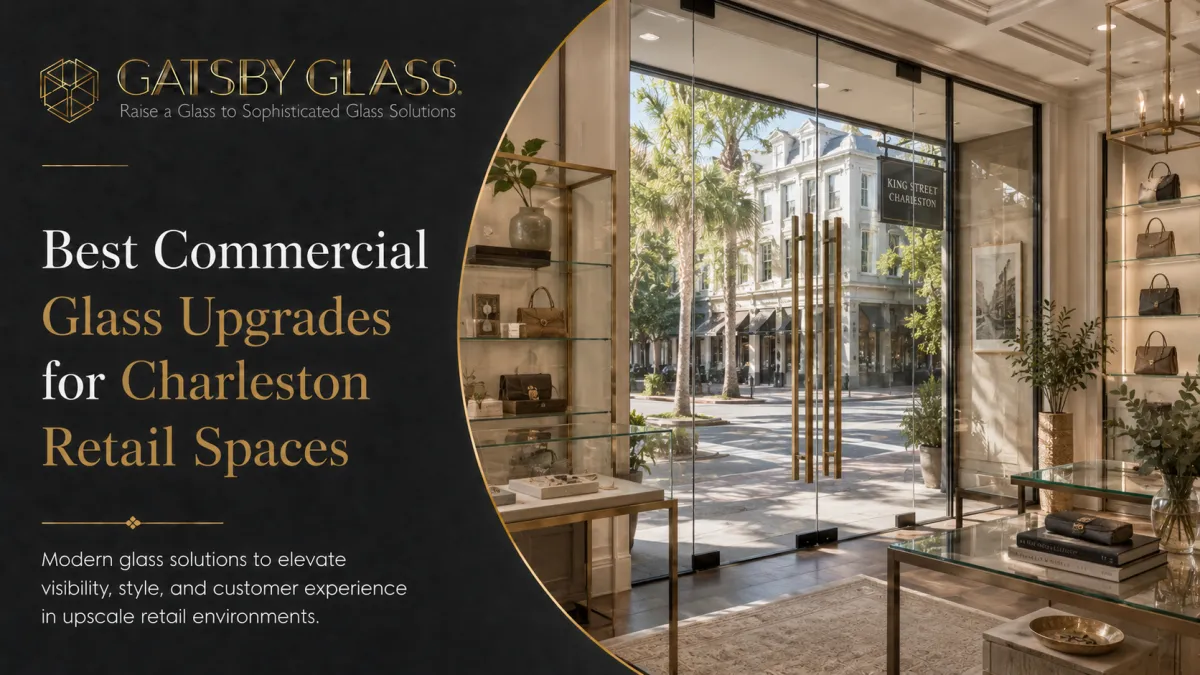
Best Commercial Glass Upgrades for Charleston Retail Spaces
Charleston's retail landscape is more competitive than ever. Discover the commercial glass upgrades that help local retail businesses attract more customers, elevate the shopping experience, and stand out on one of the South's premier retail streets.
Best Commercial Glass Upgrades for Charleston Retail Spaces
Walk King Street on a Saturday afternoon, and you can see immediately which retail businesses understand something that others are still figuring out: the physical environment is part of the product.
It's not just what's on the shelves or the racks. It's whether you can see it clearly from the sidewalk. It's whether the store feels inviting from the outside before you've committed to walking through the door. It's whether the interior environment, the light, the space, the visual organization, makes you want to stay longer, look at more things, and feel like the experience of shopping here is itself worth something.
In Charleston's retail landscape, one of the most visited and design-conscious in the American South, the businesses that get this right are consistently the ones that take their physical environment as seriously as their merchandise. And the single material that does more work in a well-designed retail environment than almost anything else is glass.
From storefront systems that stop foot traffic on the sidewalk to interior commercial glass solutions that transform how a store feels from the inside out, the right glass upgrades can change the performance of a retail business in genuinely measurable ways: in dwell time, in transaction value, in repeat visits, and in the kind of social media and word-of-mouth attention that no advertising budget can fully replicate.
This guide covers the specific commercial glass upgrades that matter most for Charleston retail businesses, what each one does, why it works in this particular market, and how to think about prioritizing the investment.
The Charleston Retail Context: Why Glass Matters More Here
Before getting into specific upgrades, it's worth being clear about why the glass conversation is particularly high-stakes for Charleston retail specifically, because the local market has characteristics that amplify both the opportunity and the cost of getting this wrong.
The Visual Standard on King Street Is High
King Street is not a generic strip mall environment where any functional retail space can compete on product and price alone. It's a street that attracts visitors who travel specifically to shop here, visitors from across the country and internationally who have a sophisticated visual literacy about retail environments and who are accustomed to the design standards of the best retail streets in major American cities.
On a street like this, the physical presentation of a retail business is part of its competitive positioning. A beautifully designed storefront on King Street competes with the boutiques of Nashville's 12 South, the shops of Charleston's own peers, and aspirational comparisons. A storefront that hasn't been updated in a decade doesn't just look dated; it looks like a business that isn't invested in its customer experience. In this environment, that signal has real commercial consequences.
Tourists Decide in Seconds
A significant portion of Charleston's retail foot traffic consists of visitors who are making browsing decisions quickly, walking a stretch of street, making instant visual judgments about which stores to enter, and allocating their limited shopping time accordingly. These visitors have no loyalty to local businesses, no prior relationship with your brand, and no reason to choose your store over the one next to it except the impression your storefront makes in the two or three seconds they spend walking past.
That two-second window is where storefront glass does its most important work. Clean, clear, well-designed glass that lets visitors see inside your store, see the merchandise, see the environment, see other shoppers, is one of the most powerful conversion tools available to a Charleston retail business. And the inverse is equally true: glass that's scratched, hazy, poorly framed, or simply not designed to showcase your interior is actively losing you sales every day.
The Historic Building Constraint
Many of Charleston's retail spaces occupy historic commercial buildings, structures with specific proportions, materials, and architectural character that set a visual context for any upgrades. The best commercial glass upgrades for these spaces are ones that respect and work with that historic context rather than fighting against it, which means understanding the original proportions of the storefront opening, the appropriate framing finishes for the building's era and style, and the visual relationship between the new glass work and the historic building fabric around it.
This is where working with a local glass expert who knows Charleston's commercial districts matters enormously. Generic commercial glass contractors apply standard solutions without that local contextual knowledge. The difference in the result is visible to everyone who walks past.
Upgrade 1: High-Clarity Storefront Glass
The foundation of any retail glass upgrade conversation is the storefront glass itself, the panels that form the face of your business on the street. And the most immediately impactful change available for most Charleston retail storefronts is upgrading to high-clarity, low-iron glass.
Standard float glass, the kind used in most commercial storefront installations, contains iron oxide that gives it a slight but clearly visible green tint, particularly noticeable when you're looking through a large panel at an angle. At the scale of a full retail storefront, this green cast flattens colors, reduces the apparent brightness of the interior, and gives the glass itself a slightly industrial quality that undercuts the premium positioning most retail businesses are trying to project.
Low-iron glass, sometimes called ultra-clear or Starphire glass, eliminates this tint. The result is a colorless, crystal-clear transparency that makes the interior of your store look brighter, colors look more accurate, and merchandise look genuinely closer to how it looks under the best display lighting. For fashion boutiques, home goods retailers, jewelry stores, and any business where the visual presentation of merchandise is central to the selling experience, the upgrade to low-iron glass makes a visible difference that discerning shoppers notice intuitively even when they can't articulate exactly what's different.
Combined with proper interior display lighting positioned to cast light toward the storefront, rather than away from it, a low-iron glass storefront in a Charleston retail space on a sunny afternoon is one of the most effective visual selling tools available at any price point.
Upgrade 2: Slim-Profile Framing Systems
The framing system around your storefront glass shapes the visual character of your facade as powerfully as the glass itself, and it's one of the areas where many Charleston retail businesses are leaving significant visual value on the table.
The heavy aluminum framing systems of the 1980s and 1990s thick profiles, visible screws, chunky corners, make storefront glass openings feel smaller than they are and impose a visual heaviness that reads as dated in almost any contemporary retail context. They were engineered for durability and ease of installation rather than for visual refinement, and it shows.
Slim contemporary framing systems, with profiles measured in millimeters rather than inches, clean mitered corners, and finishes that sit flush with the building surface, dramatically increase the apparent openness of a storefront by minimizing the visual interruption between glass panels. The storefront appears to be almost entirely glass, with the framing receding into the background rather than announcing itself. The interior becomes more visible. The merchandise becomes the visual story rather than the framing around it.
For retail businesses in Charleston's historic commercial buildings, the right framing finish matters as much as the profile. Painted aluminum in a carefully chosen color a warm dark bronze, a clean matte black, a historically appropriate dark green can make a contemporary slim-profile framing system sit beautifully within a nineteenth-century commercial facade. This is the kind of contextual detail that a local expert brings to the conversation and a generic contractor doesn't think to raise.
Upgrade 3: All-Glass Entrance Doors
The entrance door is the moment of physical contact between your customer and your store, and it registers more powerfully in the customer's experience than most retailers realize. An all-glass entrance door, frameless or nearly so, extends the visual language of the storefront through to the point of entry in a way that framed or opaque doors cannot.
The psychological effect is meaningful. An all-glass door says: we have nothing to hide, and the experience inside is worth seeing clearly before you commit to entering. It's the architectural expression of confidence, the commercial equivalent of a restaurant with its kitchen open to the dining room. Customers respond to that signal intuitively, and the result is a lower threshold to entry for browsers who might otherwise walk past.
Hardware specification matters particularly for Charleston's coastal retail environment. All-glass entrance doors in commercial glass solutions for this market should use marine-grade 316 stainless steel for handles, hinges, and pivot hardware; the same material specification that protects residential glass hardware from salt-air corrosion applies with equal force to commercial entrances that face the coastal atmosphere daily. An entrance door with corroding or pitting hardware makes exactly the wrong first impression in a market where first impressions are everything.
A well-designed all-glass entrance door with quality hardware also performs better mechanically than most framed alternatives, opening smoothly, closing quietly, and continuing to function elegantly after years of heavy use. On a busy King Street retail day with hundreds of customer entries, that mechanical quality is not a minor consideration.
Upgrade 4: Interior Glass Walls and Display Partitions
The glass conversation for retail businesses doesn't end at the storefront. Inside the store, glass walls and partitions are one of the most powerful tools available for managing the customer journey, creating visual depth, and making the interior feel more spacious and better organized than the square footage alone would suggest.
Creating Zones Without Closing Them Off
Retail spaces benefit from zone definition, a clear sense that different areas of the store have different purposes, different merchandise categories, different experiences. But traditional wall partitions create zones by closing them off, which reduces visibility from one area to another, makes the store feel smaller, and creates the "dead corner" problem where customers don't venture to areas they can't see from the entrance.
Glass partitions solve this by creating visible zone definition without visual enclosure. A glass wall separating a VIP fitting suite from the main selling floor makes the suite feel exclusive and private while making it visible and aspirational from the rest of the store. A glass partition between a jewelry display and a clothing area gives each zone its own character and pace while keeping the full store visually connected. Customers can see the entire store from most positions within it, which increases the likelihood they'll explore areas they might otherwise have passed by.
Back-of-House Glass Walls
A particularly effective retail glass application, used consistently in well-designed boutiques, coffee concepts, and specialty food retailers, is a glass wall between the public selling floor and a back-of-house workspace that benefits from being visible. A coffee bar where customers can watch their drinks being prepared through a glass wall. A bakery where the production kitchen is visible from the retail counter. A custom tailor or leather goods shop where the craft work is visible from the selling floor.
The transparency does multiple things simultaneously: it provides social proof of quality and craftsmanship, it creates visual interest and a reason to linger, and it communicates the values of the business, that the work is real, the process is worth seeing, and the people doing it are proud of it. In a retail market increasingly focused on authenticity and story, that visible transparency is a genuine competitive asset.
Upgrade 5: Custom Mirrors as Retail Design Tools
Custom mirrors in a retail environment are not purely functional, though fitting room mirrors and try-on areas make them functionally essential for fashion and accessories retail. They're design tools that serve specific commercial purposes when deployed with intention.
Expanding the Apparent Store Size
This is the most straightforward retail mirror application: a full-wall or large-format custom mirror on the back or side wall of a retail space makes the store appear significantly larger than its actual footprint. In Charleston's historic retail buildings, where the most desirable spaces often have charming but compact proportions, this matters practically and commercially. A boutique that feels spacious and uncrowded is a boutique where customers linger. A boutique that feels cramped is one they move through quickly and remember as stressful rather than pleasurable.
A properly sized custom mirror on the back wall of a compact retail space can visually double the apparent depth of the store, making a 30-foot-deep space feel like a 60-foot-deep one to a customer standing at the entrance. Combined with the right lighting, this effect can be genuinely dramatic, and it's available in even the most historic and architecturally constrained Charleston retail buildings without any structural modification.
Fitting Rooms That Sell
For fashion, accessories, and lifestyle retailers, the fitting room mirror is arguably the most commercially important in the building, because it's the space where purchase decisions are made. A fitting room with a poorly positioned, inadequately sized, or unflattering mirror is actively costing the business sales on every customer who tries something on and can't see themselves clearly or favorably.
Custom fitting room mirrors, sized for the specific fitting room dimensions, positioned and angled for the most flattering view, lit to complement rather than undercut the merchandise, are one of the highest-ROI glass investments available to fashion retailers in Charleston. The correlation between a well-designed fitting room and conversion rates is well-established in retail design research, and the mirror is the most critical element of that environment.
Decorative Mirrors as Brand Statements
Beyond functional mirrors, decorative custom mirrors oversized statement pieces in locations within the store that create natural social media moments have become a significant retail design element in the Instagram era. A well-designed large mirror in the right location in a Charleston boutique doesn't just make the space feel larger and more interesting. It creates a specific kind of user-generated content: customers photographing themselves in a beautiful retail environment that extends the store's brand presence into social media feeds organically and at no cost to the retailer.
This is a detail that savvy retailers are designing for intentionally, and a custom mirror is the most accessible and elegant way to create it.
Upgrade 6: Glass Display Cases and Shelving
Glass display cases and glass shelving units are upgrades that sit at the intersection of function and design, and for specific categories of retail, they're among the most commercially important glass investments available.
For jewelry retailers, luxury goods boutiques, specialty food and spirits retailers, and any business where the product benefits from being displayed at close range while being protected from handling, a well-designed glass display case is essential infrastructure. But the quality of that infrastructure varies enormously, from the dated, heavy-framed cases that feel more like a museum exhibit than a luxury retail experience to the sleek, minimal, nearly frameless cases that make the product feel precious and desirable.
Contemporary glass display cases for premium retail should use low-iron glass for maximum clarity; the same upgrade that matters for storefront glass matters even more for display cases where customers are looking through multiple glass surfaces at the product. Slim framing, LED lighting integrated into the case structure, and locking systems that don't interrupt the visual cleanliness of the case design are all details worth specifying from the beginning rather than addressing as afterthoughts.
Glass shelving, panels of tempered glass supported by minimal hardware, does something specific to how merchandise reads in a retail environment. Unlike solid shelving that divides a display wall into separate horizontal bands, glass shelving allows light to travel through the full height of the display, making the entire wall feel luminous and making every product on every shelf equally visible from a distance. For boutiques and specialty retailers who invest significantly in their visual merchandising, glass shelving is one of the cleanest ways to let that merchandising work at its full potential.
Upgrade 7: Insulated Glass for Energy Efficiency
This is the upgrade that retail business owners sometimes resist because it feels less visible than the others, but it has a direct and measurable impact on operating costs that makes it worth taking seriously, particularly in Charleston's climate.
Standard single-pane commercial storefront glass provides essentially no thermal resistance between the exterior and the conditioned interior of the store. On a Charleston summer afternoon, when temperatures are in the 90s and humidity is equally oppressive, a south or west-facing retail storefront with single-pane glass is functioning as an enormous solar collector, driving cooling loads that translate directly into energy costs. The merchandise nearest the glass can also be affected by UV exposure and heat, which is a genuine product care issue for fashion retailers with sun-sensitive fabrics or dyes.
Insulated glass units, double-pane systems with argon fill and low-emissivity coatings, dramatically reduce both solar heat gain and UV transmission without affecting the visual clarity of the storefront. The energy savings on a Charleston retail space with significant sun exposure can be substantial enough to materially affect the bottom line of a small or medium-sized retail business over the course of a full year.
The upgrade is best addressed during a storefront glass replacement rather than as a standalone project; the incremental cost of insulated over single-pane glass is modest relative to the total cost of a new storefront system, and the cumulative energy savings over the life of the installation make it a clear financial decision in this climate.
Upgrade 8: Glass Railings for Multi-Level Retail
For retail businesses occupying multi-level spaces, a category that includes some of King Street's most significant retail properties, as well as growing numbers of multi-story boutiques and concept stores in Charleston's commercial districts, glass railings on staircases, mezzanines, and upper-level balconies are one of the highest-impact visual upgrades available.
The functional argument for glass railings in a retail setting is that they maintain sightlines between floors. A customer on the ground floor can see the merchandise on the upper level. A customer on the mezzanine can see the activity on the main floor. This visual connectivity encourages customers to explore the full store rather than stopping at the first floor, a genuine commercial benefit in multi-level retail where upper-floor traffic is consistently lower than ground-floor traffic when the connection between levels feels visually opaque.
The design argument is equally compelling. Glass railings make a multi-level retail space feel genuinely dramatic, the kind of environment that photographs well, reads as premium, and gives customers the sense that the retailer has invested seriously in their experience. Combined with quality interior lighting that makes the glass glow, a glass-railed staircase in a Charleston boutique becomes a design signature rather than a transitional element between floors.
How to Think About Prioritizing These Upgrades
For a retail business working with a realistic budget, not every upgrade can happen simultaneously. Here's a practical framework for thinking about sequencing.
Start with the storefront: This is where the return on investment is highest because it affects every potential customer before they've made the decision to enter. High-clarity glass and a refined framing system, combined with an all-glass entrance door, constitute the single highest-impact glass investment available to a Charleston retail business. If resources only allow for one project, start here.
Add interior mirrors second: The combination of a well-designed storefront and properly scaled custom mirrors inside the store covers the two highest-impact glass applications for most retail categories. Custom mirrors are also typically the most cost-efficient interior glass upgrade relative to their visual impact.
Consider glass partitions and display elements as the interior build-out matures: Glass walls, partitions, and display cases are more significant investments that make the most sense as part of a comprehensive interior design refresh rather than standalone projects. If you're planning a broader renovation, incorporate these elements from the beginning rather than adding them later.
Address energy performance proactively: Insulated glass is best addressed when the storefront glass is being replaced anyway; the incremental cost is modest, and the long-term savings are genuine.
The Coastal Durability Factor for Charleston Retail Glass
Any commercial glass installation in Charleston's coastal environment needs to account for the specific material stresses of salt air, high humidity, and intense UV exposure, and retail glass is no exception.
Marine-grade 316 stainless steel for all entrance hardware is the baseline specification for any coastal retail installation. Quality exterior-grade sealants with appropriate UV resistance. Hydrophobic coatings on storefront glass that reduce salt residue accumulation and extend the interval between professional cleaning. These specifications cost modestly more than standard commercial glass work and last dramatically longer in this environment, a straightforward value proposition for any retail business planning to occupy their space for five or more years.
The team at Gatsby Glass of Charleston understands these coastal specifications as standard practice rather than premium upgrades, because working in this market every day means knowing what holds up and what doesn't. That embedded local knowledge is one of the things that makes the difference between a commercial glass installation that looks great for a decade and one that starts showing its age within a few years of installation.
Ready to Elevate Your Retail Space?
Charleston's retail landscape rewards businesses that take their physical environment seriously. The customers who walk this city's streets, residents with high design standards, and tourists who've traveled to experience the best of what Charleston offers notice the difference between a retail environment that's been thoughtfully designed and one that hasn't. And they make spending decisions accordingly.
The glass upgrades described in this guide aren't cosmetic niceties. They're commercial investments that affect foot traffic, dwell time, conversion rates, average transaction value, and the kind of memorable experience that drives repeat visits and word-of-mouth recommendations. In a competitive retail market, those are the variables worth investing in.
Whether you're planning a full retail buildout, a targeted storefront upgrade, or a comprehensive interior refresh, the team at Gatsby Glass of Charleston brings the commercial glass expertise and the local market knowledge to help you get the most from your investment. Reach out to schedule your free commercial glass consultation; they'll assess your specific space, understand your retail category and customer profile, and give you honest, prioritized recommendations that fit your timeline and your budget.
Gatsby Glass of Charleston serves businesses and homeowners across Charleston, Mount Pleasant, Summerville, West Ashley, James Island, Folly Beach, Isle of Palms, and surrounding South Carolina areas. Call (843) 350-5141 or visit gatsbyglasscharleston.com to schedule your free consultation.