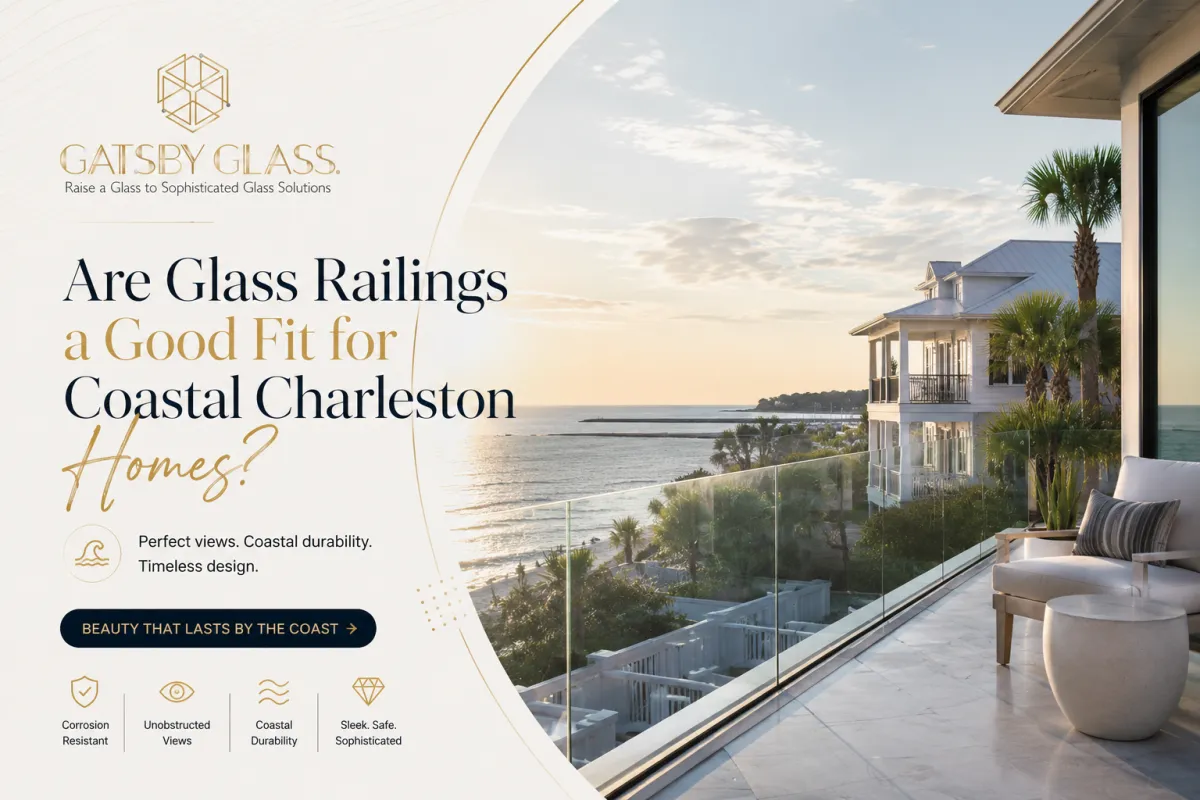
Are Glass Railings a Good Fit for Coastal Charleston Homes?
Salt air, high humidity, and stunning waterfront views, Charleston's coastal homes need railings that can handle the climate and the scenery. Here's an honest look at whether glass railings are the right choice for your property.
Stand on the deck of a home on Sullivan's Island, Isle of Palms, or Folly Beach, and you immediately understand the problem with traditional railings. The view is extraordinary, the Atlantic stretching out in front of you, marsh grass swaying behind, the sky doing something spectacular with the late afternoon light, and right in the middle of it, cutting directly across your sightline, is a row of wooden balusters or metal spindles that chop the whole picture into segments.
It's one of those things you can't unsee once you notice it. The railing is doing its job structurally, but it's working against everything that makes the location special.
This is exactly why so many coastal Charleston homeowners have started asking about glass railings, and exactly why the question deserves a thorough, honest answer rather than a simple yes or no. Because the coastal environment here isn't just beautiful. It's also genuinely demanding in terms of building materials. And before you invest in any railing system, it's worth understanding how glass actually performs in this specific climate, what maintenance looks like long-term, and where it genuinely makes sense versus where another option might serve you better.
Let's get into it.
What Makes Charleston's Coastal Climate So Hard on Railings
If you've lived near the water in the Lowcountry for any length of time, you already know that salt air doesn't play favorites. It finds metal and starts oxidizing it. It finds wood and accelerates rot and warping. It finds paint and peels it. The combination of high humidity, salt particulate in the air, intense UV exposure during summer months, and the occasional hurricane-force wind event creates one of the more challenging environments on the East Coast for exterior building materials.
Traditional railing materials each have their own vulnerabilities here. Wrought iron rusts without meticulous maintenance. Aluminum holds up better, but still corrodes over time at the connection points. Wood, even pressure-treated wood, requires regular sealing, staining, and eventual replacement in a coastal environment. Composite decking materials have gotten much better, but they still don't love UV exposure over the long term.
Glass, somewhat counterintuitively, handles the coastal environment better than most people expect. Here's why that is, and what you need to understand about the hardware, which is the part of the equation that actually requires attention.
How Glass Railings Actually Perform in Salt Air
The glass panels themselves are not the vulnerability in a coastal railing installation. Tempered or laminated safety glass, the type used in all quality glass railing installations, is essentially impervious to salt air, UV radiation, and humidity. It doesn't rust, doesn't rot, doesn't warp, doesn't fade, and doesn't require sealing or staining. Left unmaintained, the worst that happens to the glass itself is that it accumulates salt residue and looks hazy, a problem solved entirely by rinsing it down with fresh water.
The hardware is a different conversation. Posts, clamps, standoffs, top rails, and base fittings are the metal components that hold the glass in place, and this is where material selection matters enormously in a coastal environment.
The right answer here is marine-grade stainless steel, specifically 316-grade stainless, which contains molybdenum and has significantly better corrosion resistance than the more common 304-grade. For coastal properties within direct spray distance of the ocean, homes on Sullivan's Island, the front-facing properties on Isle of Palms, and any structure close enough to the water that salt spray reaches the exterior, 316-grade stainless hardware is not a premium option. It's a baseline requirement.
When glass railings are specified and installed correctly for the coastal environment, with the right glass thickness, the right hardware grade, and the right mounting approach, they are genuinely one of the most durable railing options available for Charleston's waterfront and near-water properties. The keyword is correct. This is not an installation where cutting corners on material specification makes sense.
The View Factor — Why It Matters More Than You Might Think
Let's come back to that deck view for a moment, because it's not purely an aesthetic consideration. It's also a financial one.
In Charleston's coastal real estate market, particularly on the barrier islands and in the waterfront communities of Mount Pleasant, James Island, and Johns Island, a water or marsh view adds measurable value to a property. Buyers pay premium prices specifically for those sightlines. And anything that interrupts or diminishes those sightlines is working against the value of the property.
Traditional railings with vertical balusters cut your view into narrow columns. Horizontal cable railings are better; they at least let you see between the cables, but they still segment the view, and they require significant tension maintenance to stay code-compliant over time. Glass railings eliminate the obstruction. The view from your deck, balcony, piazza, or rooftop terrace is the full, uninterrupted panorama you paid for.
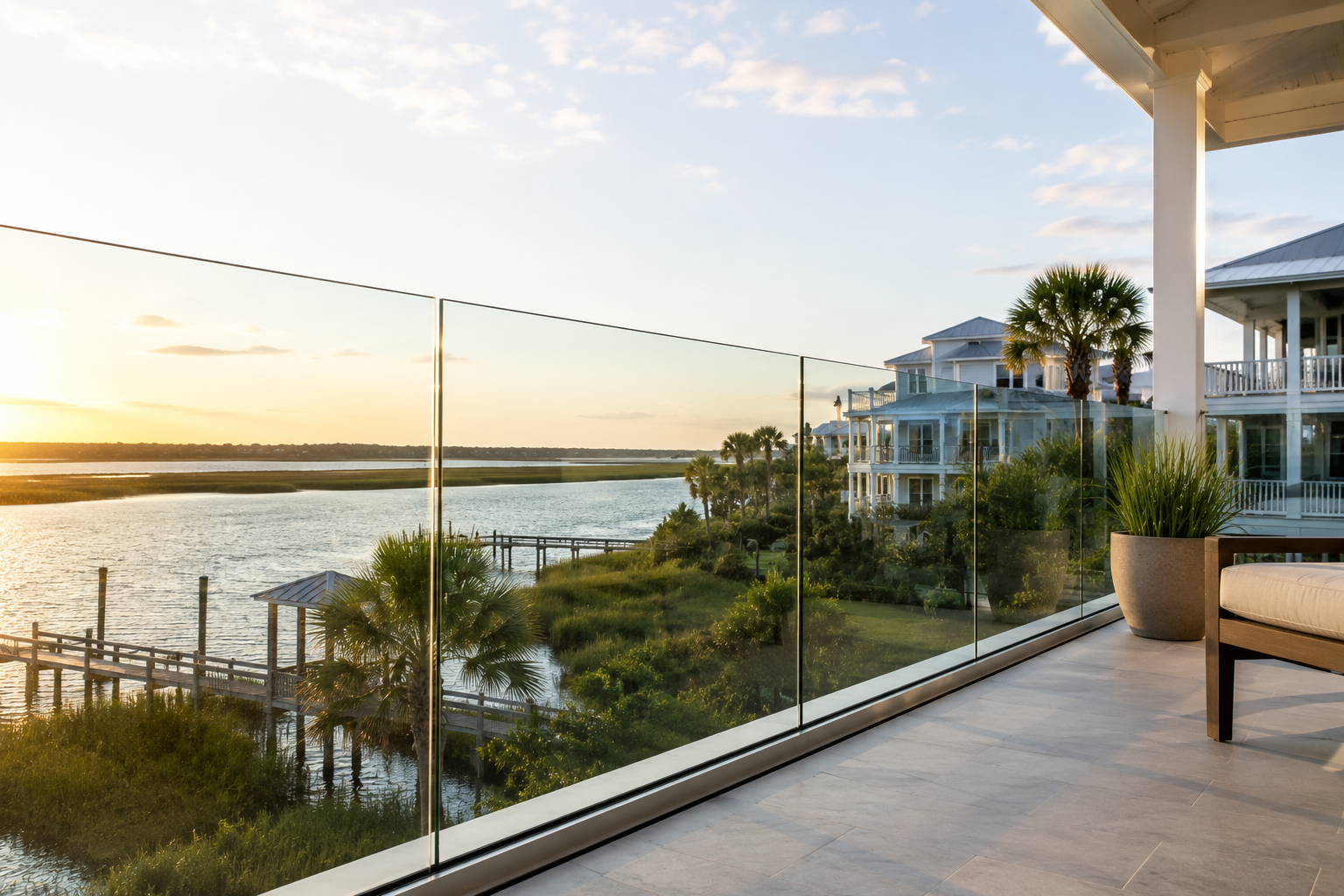
From a purely practical standpoint, if your home has a water or marsh view, glass railings are the only railing system that doesn't work against your property's most valuable feature.
Decks, Balconies, Piazzas, and Staircases — Where Glass Railings Work Best
Elevated Decks and Balconies
This is the most straightforward application and the one where the benefits are most obvious. An elevated deck on a coastal home with glass railings reads completely differently from one with traditional balusters; it feels like a platform suspended in the landscape rather than a cage around the edge of a house. The visual connection to the surrounding environment is total.
For homes on the back side of the barrier islands, where decks overlook tidal creeks and marsh one of Charleston's most stunning and underappreciated views glass railings make that connection between indoors and outdoors feel seamless. If you've been thinking about making more of your outdoor living space, pairing a glass railing system with other thoughtful glass upgrades like frameless shower enclosures inside the home creates a cohesive design language where openness and light are consistent themes throughout the entire property.
The Charleston Piazza
The iconic Charleston piazza, the long side porch that runs the full length of a single-house or double-house, is one of the city's most distinctive architectural features. On historic homes downtown and in the older residential neighborhoods, the piazza is where life happens: morning coffee, evening conversation, watching the street below. Traditional piazza railings are typically wood, often painted, and require significant upkeep in the humidity.
Glass railing panels on a piazza are increasingly common on renovated historic homes, and when they're done with sensitivity to the architecture, thin profiles, minimal hardware, and the right glass, they look genuinely beautiful. They're also dramatically lower maintenance than painted wood, which in Charleston's climate means repainting every few years, minimum.
Interior Staircases
This is the residential application that surprises people most in terms of the transformation it creates. A staircase with a glass railing, whether frameless glass panels or glass with a top handrail, opens up the vertical space of a home in a way that wooden balusters simply cannot. Light from upper-floor windows travels down through the stairwell. The floors above and below feel visually connected. What was previously a functional but forgettable part of the house becomes one of its most distinctive features.
In renovated historic homes downtown, where staircases are often central to the floor plan and quite beautiful in their own right, glass railings can honor and elevate the existing architecture. The glass recedes; it doesn't compete. The original staircase details remain the hero. And if you're already thinking about the full interior design picture, custom mirrors at the base or landing of a staircase paired with glass railings above create a light-filled vertical experience that feels genuinely architectural.
Commercial Decks and Rooftop Spaces
Charleston's hospitality scene, its rooftop bars, waterfront restaurants, and boutique hotels, has embraced glass railings more enthusiastically than almost any other commercial category. The reason is simple: a rooftop bar with glass railings gives every guest an unobstructed view of the Charleston skyline, the harbor, or the surrounding neighborhoods. That view is the product. Glass railings protect it.
For commercial property owners considering outdoor space upgrades, glass railings are one of the most impactful investments available. Combined with thoughtful commercial glass solutions inside the building, storefront glass, interior partitions, and entrance systems, they create a property that reads as premium from every angle.
The Honest Maintenance Conversation
Glass railings are low maintenance — but they are not zero maintenance, and in a coastal environment, it's worth being clear about what that actually means.
Salt residue: Homes within proximity to the ocean will see salt film accumulate on glass surfaces, particularly after storms or periods of onshore wind. This washes off completely with fresh water; a garden hose handles it, but if it's left to build up over extended periods, it can etch into the glass surface permanently. The practical solution is a simple rinse-down after significant weather events and a monthly freshwater wash during summer months. It takes about ten minutes.
Hardware inspection: Even with marine-grade stainless hardware, an annual inspection of clamps, standoffs, and connection points is worthwhile on coastal properties. You're looking for any early signs of surface corrosion, checking that hardware is tight, and making sure nothing has shifted. This is a quick check, not a major maintenance event, but it extends the life of the installation significantly.
Glass cleaning: For the genuine clarity that makes glass railings spectacular, a proper glass cleaning with an appropriate cleaner, a few times a year, does the job. Between cleanings, the glass still looks good, but it just looks its best when it's genuinely clean.
Compare this maintenance profile to wood railings, which require sanding, staining, or painting, and eventual replacement in this climate, or to metal railings that need rust treatment and repainting, and glass begins to look like the genuinely low-effort option it actually is.
What to Ask Before You Commit to Glass Railings
If you're seriously considering glass railings for a coastal Charleston property, these are the questions worth getting clear answers to before installation begins.
What grade of stainless steel is the hardware? The answer should be 316-grade for any coastal installation. If a contractor proposes 304-grade on a waterfront property, that's a flag worth discussing.
What thickness is the glass? For exterior railings, 1/2-inch tempered glass is the standard for most installations. Thicker glass is available for higher-load or higher-exposure situations.
Is the glass tempered, laminated, or tempered-laminated? All three are used in railing applications. Tempered glass is the most common. Laminated and tempered-laminated offer additional safety characteristics; if the glass breaks, it holds together rather than shattering. For elevated applications or situations where falling glass could be dangerous, this is worth discussing.
What is the warranty? A quality installation should come with a warranty on both materials and workmanship. At Gatsby Glass of Charleston, every installation comes with a two-year warranty, which is a reasonable baseline for a premium installation.
So, Are Glass Railings Right for Your Coastal Charleston Home?
The honest answer is: for most coastal Charleston properties, yes, provided the installation is done correctly with the right materials for the environment.
If your home has a view worth protecting, glass railings are the only railing system that doesn't work against it. If you're renovating a piazza or balcony and want something that will hold up in the salt air with minimal maintenance, properly specified glass with marine-grade hardware is genuinely one of the most durable options available. If you're updating an interior staircase and want to transform how light moves through your home, glass railings do something no other material can replicate.
The caveats are real, hardware specifications matter, maintenance can't be entirely ignored, and installation quality makes a significant difference in long-term performance. But none of these are reasons to rule glass out. They're reasons to work with someone who knows what they're doing in this specific environment.
That's exactly what the team at Gatsby Glass of Charleston brings to every railing project: local knowledge, coastal experience, and the kind of honest conversation about materials and expectations that leads to installations that still look great five and ten years down the road. Reach out to schedule your free design consultation and find out what glass railings would look like on your specific property.
Gatsby Glass of Charleston serves homeowners and businesses across Charleston, Mount Pleasant, Summerville, West Ashley, James Island, Folly Beach, Isle of Palms, Sullivan's Island, and surrounding South Carolina areas. Call (843) 350-5141 or visit gatsbyglasscharleston.com to get started.